For many, Howl’oween is the most popular event on the pet calendar. Going trick-or-treating is a wonderful way to have some family fun and spend good quality doggie time together. But let’s get real; it’s not about the tricks, it’s all about the treats.
During the festivities, it’s essential that you keep an eye on all the treats—both coming and going— to prevent your pets from eating anything that could potentially make them sick. You also need to ensure your pets can’t access the kids’ treat stash when no one is looking. (Chocolate is toxic for dogs and candy is as bad for canine teeth as it is for humans.
Fortunately for your canine companions, most doggy bakeries go to town for Howl’oween, making biscuits in all sorts of appropriately festive shapes—witches, bats and ghosts. It is also really easy to make your own. You could even turn the baking into a fun pre-Halloween family event. No doubt your dog will be only too happy to be on hand to taste test.
Author/chef Cheryl Gianfrancesco has a new book called “Doggy Desserts” (CompanionHouse Books) and it features some fun recipes that your dog and neighborhood pooches will enjoy. Below are two of them.
Trick-or-Treating Safety
Children should never be in charge of the dog during their neighborhood outings; there are far too many distractions. Holding a flashlight and a candy bag is probably all they can handle. Instead, make sure your dog is on a strong leash with an adult on the other end. You should also be careful about letting your dog go up to a front door in case the resident pooch is not amenable to visiting canines.
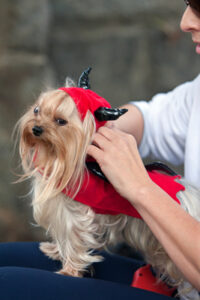
In addition, remember that not every dog will like to dress up in full costume, some of which can be really stifling. A fun bandana or a glow-in-the-dark collar and leash are good alternatives for dogs who don’t like wearing a getup but enjoy getting into the spirit of the occasion.
Lastly, be sure to take plenty of water along for your dog to lap up in route and double check that he’s wearing ID.
About the Author: Sandy Robins is the 2013 winner of the “Excellence in Journalism and Outstanding Contribution to the Pet Industry Award.” Her work appears on many of the country’s leading pet platforms, such as MSNBC.com, MSN.com and TODAYShow.com. She is a regular contributor and columnist in multiple national and international publications, including Catster, as well as the author of the award-winning books “Fabulous Felines: Health and Beauty Secrets for the Pampered Cat” and “For The Love of Cats.” Learn more about Sandy on her website or Facebook page. #welovecats
How to celebrate the holiday’s spooky fun without freaking out your dog.
Photo credit: mdmilliman/iStock
We’re fast approaching the spookiest night of the year for dogs (and cats). Halloween can be particularly difficult for our dogs, who are assailed with new noises, doorbells ringing, and scary kids in costumes. This is a stressful time for animals, but with a little planning, you can make it an enjoyable and stress-free holiday for your four-legged family members. Here are my tips:
Leave the Trick-or-Treating to Humans
You might think your dog loves heading out to see all of the children dressed up in costumes, but the truth is, you’re putting your dog at risk to be injured, your neighbors at risk for being bitten and yourself at risk for a lawsuit.
As much as we love to celebrate Halloween, our dogs might not be as enthusiastic when it comes to crowds, unruly children and loud noises. Photo credit: Dean_Fikar/iStock
This is the time of year that your dogs are most likely going to be happier indoors, away from noise, and out of range of doorbells being rung for hours on end. Consider crating your dog during this stressful time, or putting her into a room with a Kong toy and some relaxing classical music (although my pets prefer Enya).
By the way, if you’re looking for a great way to keep your kids visible, the pet industry has some of the best products on the market. Check out the PupLight, which you or your child (or your dog) can wear for easy nighttime illumination and visibility for up to a mile.
Train Your Dog to Ignore the Doorbell
Training dogs not to react when the doorbell rings is one of the greatest things you can do for them. The best way to do this is to start when they’re puppies and help them grow accustomed to noises gradually. However, if your dog is already reactive, you can help in several ways. My website, PetsWeekly, has a detailed training method that can help you teach your dogs to ignore the doorbell. It’s important to start now.
Beware of Candles
Candles go hand-in-hand with All Hallows’ Eve, but it’s very important you avoid the use of candles if you have pets. This is especially true if you do decide to have your pet to wear a costume—a dog need only brush against an open flame or wag her tail the wrong way to catch fire.
Rather than using candles, consider using flickering LED lights to illuminate that jack-o-lantern. Technology has given us some cool replacements for candles.
Costumes or Paint
When it comes to costume safety, the best dog outfits are those that do not hinder a dog’s legs, cover the face or flair out on the sides. Photo credit: BluIz60/iStock
Ideally, you should prefer your dog in her natural state, but if you do feel the need to dress her up, remember that her dog costume should be made with the same care as those for children (I recommend dressing your dog during the calmer time of day, taking photos and then removing the costume). Costumes can be quite stressful to dogs and if you’re in the Southwest, they can also be very hot and could cause heatstroke.
The best costumes are the most minimal, such as a bowtie that clips to the collar, a lion’s mane or a simple coat to stay warm. If you really want to put a costume on your dog, be sure it’s safe, made from fire-retardant material and can be easily removed in case your pet becomes distressed.
Another less-stressful option is specialty, nontoxic pet paint. The paint usually wears off after a bath or two, and the easiest-to-use versions are available as a spray or coloring pen. Never, ever use paint or dye that isn’t specifically designed for pets (and never use any type of paint on birds or reptiles).
Keep Treats Out of Reach
There are so many toxic products that dogs can get into during this time of year, that I am unable to list them all. You must find a way to keep candy and other dangerous foods out of your dog’s reach. This often means discussing the dangers of leaving candy lying about with your kids and housemates.
Halloween means chocolate–lots of chocolate–as well as other treats that are dangerous to dogs if ingested. Make sure to keep any and all human treats out of your dog’s reach. Photo credit: Fiantas/iStock
Pet Poison Hotline is a great resource to keep on hand—there are apps for your cellphone and iPad, as well as a special number to call in case of emergency. Calls cost $39 but might save you an expensive emergency veterinarian fee if you call them first.
Keep Deadly Decorations Out of Reach
Decorations are very dangerous for pets. Whether it’s decorative corn, glow-sticks, plastic party pieces or wires and cords, decorative items present choking hazards and the possibility of bowel obstructions, not to mention possible burns or electrocution.
Wrappers are also a favored danger by pets because they make noise, smell wonderful and humans always seem to leave them lying around. Keep a close eye on your kids and make sure they are properly disposing of candy wrappers and any leftover pieces of candy that fall onto the floor.
ID is Imperative
It is particularly important that your pet is microchipped, wearing proper ID and is up-to-date on vaccinations during Halloween. This is a great time to make sure the microchip register has your current information. You might consider registering your dogs’ microchips at Found Animals, where a grant has helped make this free nationwide registry available to all pet owners (no matter what brand of chip your pet has).
About the Author: Stacy Mantle is a fulltime freelance writer, bestselling author and founder of PetsWeekly.com. She resides in the deserts of the Southwest with a few dogs, several cats and a very understanding husband.
Rating A+ The BBB only accredits the business management of a school, not the quality of the curriculum, or training programs.
STATE LICENSURE AND APPROVAL
Animal Behavior College is a private vocational school approved by the Bureau for Private Postsecondary Education (www.bppe.ca.gov) under the California Private Postsecondary Education Act of 2009 and Title 5. California Code of Regulations Division 7.5. Private Postsecondary Education. The Bureau for Private Postsecondary Education approval means that this institution and its operation comply with the standards established under the law for occupational instruction by private postsecondary educational institutions. Institutional approval is subject to continual review and the institution must reapply for approval every five years.
DISCLAIMER
Please be advised that Animal Behavior College (“ABC”) is the exclusive entity authorized to provide certifications and/or degrees from Animal Behavior College. Moreover, such certifications and/or degrees are only conferred by ABC following a student’s completion of an ABC-administered program. No other entity or individual has authority to confer certifications and/or degrees on ABC’s behalf. Any other entity or individual who attempts to do so is acting without express or implied authority from ABC.
GI BILL® TRADEMARK ATTRIBUTION
GI Bill® is a registered trademark of the U.S. Department of Veterans Affairs (VA). More information about education benefits offered by VA is available at the official U.S. government Web site at https://www.benefits.va.gov/gibill
Animal Behavior College, 27509 Avenue Hopkins, Santa Clarita CA 91355-3910 Contact Us