President Theodore Roosevelt once said, “Far and away the best prize that life has to offer is the chance to work hard at work worth doing.” Professional dog trainers enjoy the satisfaction of transforming lives–both canine and human. For a true dog lover, teaching dogs the obedience skills they need to live a happy life as well-trained, beloved companions could be considered their higher calling! Roosevelt was only half right in valuing a job worth doing. Finding a job you love doing is important too, one that lets you follow your passion. For a dog lover who wants to give them their best chance at a good life, dog training is both fulfilling and fun.
What Makes Dog Training a Worthy Profession?
Dog trainers give dogs a good shot at a happy life by teaching them behaviors that help them exist in a human environment. Obedience trainers work with owners and their dogs to instill basic commands.
Ideally, training begins during puppyhood, when dogs are most impressionable and before bad habits have had a chance to take deep roots. Everyone has heard the saying, “You can’t teach an old dog new tricks.” You actually can, but it could be a bit harder!
Obedience training ingrains the commands “sit,” “stay,” “down,” “come,” “leave it,” and others. Dogs being able to immediately respond to these simple words–or hand signals–means that owners have a good chance of controlling them in any situation. This makes life easier and more peaceful. Who hasn’t had the unpleasant experience of being around a dog who barks constantly, jumps on people, or is underfoot begging whenever food is present? Obedience training gives you the tools to shape a dog’s behavior.
A happy household is important, but obedience training can be life-saving, too. Being able to recall a dog from a potentially dangerous situation or to command her to leave something hazardous alone can avert tragedy.
Steps to Becoming a Dog Trainer
Understand a trainer’s role. Obedience trainers don’t just train dogs; they educate humans, too. Without the participation and collaboration of owners and other members of the household, it’s almost impossible to achieve the best results. Don’t go into dog training thinking people skills are unnecessary.
Assess your skills and commitment level. Dog training isn’t a cookie cutter job. Every dog has its own personality and ingrained behaviors that need to be reshaped. You have to have a deep bag of tricks to meet the challenges of different dogs, especially older dogs.
Do a little homework on training philosophies. Most modern trainers have disavowed punishment as a means of training. LIMA (least invasive, minimally aversive) techniques have replaced them. Positive reinforcement training employs rewards, such as treats or play. Fear-free training assures stress and anxiety have no part in teaching a dog good behavior.
Compare schools to make sure you find a good fit for your schedule and budget while also getting a great foundation in training. Brick and mortar schools are few and far between, but there are some excellent schools offering programs online, such as Animal Behavior College (ABC). ABC offers a hybrid solution that gives you the convenience and affordability of online learning with in-person experience; anyone hoping to become a dog trainer can learn the career while retaining a full time job and managing other life commitments.
Get hands-on training. In addition to a solid, interesting curriculum created by professional dog trainers, ABC offers students invaluable real-world experience. Through the externship, students get expert in-person instruction. They also have the opportunity to train shelter dogs through the school’s Students Saving Lives (A trained shelter dog has a much better chance of being adopted.)
Having certification helps. ABC’s certification is well-regarded in the dog training profession and is recognized by the Certification Council for Professional Dog Trainers, the International Association of Animal Behavior Consultants, the International Association of Canine Professionals, and the National Association of Dog Obedience Instructors.
Launch your career! Whether you are looking for a great side gig or full time employment, dog obedience trainers can pursue several different avenues. You could apply to work for an established company that offers dog training or obedience classes. Some pet store chains, such as Petco and PetSmart, offer dog training classes. Dog training also lends itself well to starting your own business. The ABC course includes information on job hunting and starting your own business.
Continue learning! Obedience training isn’t the only option out there. Dog trainers can specialize in different areas to offer more services to their clients, such as pet sitting, pet massage, daycare, or nutrition consulting. Trainers can also specialize in areas such as behavior modification, agility training, or military and police dog rehabilitation. Service dog training is also an amazing experience. To be able to work with service dogs to ultimately help people with disabilities is a rewarding career path.
Follow Your Heart
Your dog training career can take you wherever your passion leads you, but it all starts with getting a grasp of the basic fundamentals of training. Animal Behavior College has been helping trainers launch rewarding careers since 1998. Give us a call at 800-795-3294; an admissions counselor will be happy to help you get started.
How can you become a dog trainer for service dogs? If you already have experience as a dog obedience trainer, it can be just a matter of taking a master trainer course. If you already understand dog behavior and know how to work with dogs using positive reinforcement techniques, a certification course can teach you everything you need to know to begin training service dogs.
Our online Service Dog Training Program takes about 8 months to complete. In our course, you’ll learn:
All the different types of service dogs
What characteristics to look for when selecting a dog to train
Requirements and regulations regarding service dogs
How to maintain the health of these hard-working animals
How to train a dog to remain focused and on task in all kinds of environments
How to chain the behaviors that the dog will be performing for a specific handler
How to communicate with and help clients for whom you are training dogs
What Do Mobility and Psychiatric Service Dogs Do?
Service dogs can be trained to help people with almost every disability imaginable! In fact, their assistance can be invaluable. Many people are able to live independently only because of the tasks their service dogs perform.
People with both mental and physical disabilities can benefit from having a service dog.
Psychiatric service dogs assist people with mental issues such as anxiety, obsessive-compulsive disorder, or post-traumatic stress disorder (PTSD) . They can interrupt nightmares, flashbacks, self-harm, and other episodes; they can provide comforting physical contact; they can also be trained to do things like turn on lights to prevent a handler having to enter a dark room.
Physical disabilities come in many forms, and dogs can be trained to assist with many of them.
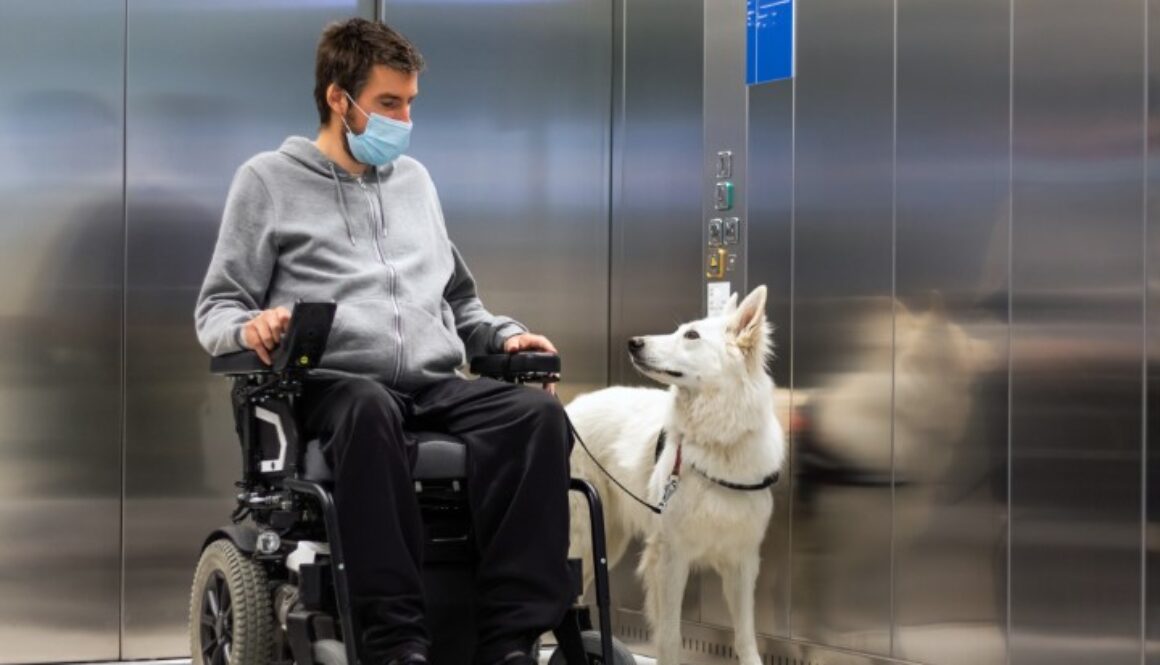
Mobility service dogs help people move about. These sturdy dogs can pull wheelchairs or offer support for people who need a brace to stand or who have balance problems.
Mobility service dogs can also be trained to open and close doors, retrieve dropped items, and fetch things like a phone or medication. They can even help their handler get dressed.
For some handlers with medical conditions, it is necessary for their dogs to be able to perform such vital tasks as calling for or getting help in an emergency, letting EMS personnel into a home, or putting a person into the recovery position.
You Can Help Fill a Growing Need for Service Dogs
The need for service dogs far exceeds the number of trained dogs available, so as a service dog trainer you can be sure your skills are needed.
If you’re ready to take your training abilities to the next level and make a vast difference in the lives of people with disabilities, ABC is ready to teach you. You can enroll in our online program any time.
And if you’re interested in service dog training but need to learn the basics of dog training, we can help with that, too. ABC has been certifying dog obedience trainers since 1998!
Service Dog Trainers Take Their Skills to the Next Level
Dog trainers all have one thing in common: their job allows them to help animals and people live better lives. Whether it’s an obedience trainer teaching a class full of puppies how to walk politely on a leash or a service dog trainer teaching a labrador to open a door or retrieve something for her owner, the work trainers do is important and rewarding.
Obedience trainers mold dogs into good canine citizens and, in the process, make life better for them by instilling desired behaviors. Well-trained dogs know what is expected of them and make life smoother for everybody concerned.
Service dog trainers, on the other hand, have a much more complex task. Not only do they have to train dogs to obey basic obedience commands like “sit,” “stay,” “down,” and “come” but they also have to teach these working dogs the tasks that will allow handlers with disabilities to live more comfortably and independently.
Why Does a Service Dog Trainer Need Extra Training?
Service dogs are working dogs with important responsibilities. For some people, their life can depend on their dog’s training. Psychiatric service dogs provide invaluable support to individuals coping with post-traumatic stress disorder (PTSD) and other mental illness. These highly trained canines offer a range of practical assistance, from alerting their owners to signs of anxiety or panic attack or interrupting destructive thought patterns to creating physical barriers or guiding them to a safe or quiet place in crowded or overwhelming environments, all while offering companionship and a sense of security.
With that in mind, it’s clear that service dog trainers take on a lot of responsibility and must know what they’re doing.
Learning how to become a service dog trainer starts with being a competent obedience trainer. You need to know how to teach a dog basic commands with the goal of instilling impeccable manners and the ability to handle all sorts of distractions without becoming reactive.
The Americans with Disabilities Act (ADA) mandates that service dogs have almost unlimited access to public spaces and businesses. Therefore, they must be prepared to deal with noise, crowds, traffic, other animals, elevators and escalators, and whatever else modern life throws at them.
Of course, the other part of service dog training is task-oriented. The types of things service dogs have to perform far exceed learning simple tricks like “shake” or “play dead.” Trainers need to be able to assess a specific task like retrieving medication or turning on a light and break it down into teachable steps, or behavior chains.
Service dog trainers also need to learn how to be attentive to the special needs of a service dog. A lot is required of these animals, and paying close attention to their health and well-being is important. Service dogs are asked to suppress their natural instincts and stay alert and on task while working. These loyal animals will often work through pain or illness, to their own detriment.
To be clear, there is a vast difference between a highly trained service dog and an emotional support animal or a therapy dog. There is a lot of confusion these days because so many more people have dogs with them in public places and some of them have vests on and some don’t. Sadly, some are misrepresented as service dogs when they are not.
Only service dogs trained to perform specific duties to help persons with disabilities are protected by the ADA. Therapy dogs do not receive the same level of training, and emotional support animals may have no training at all.
Interested in Becoming a Service Dog Trainer?
Demand for service dogs is higher now that more and more people are realizing how much these amazing animals can do to improve quality of life for someone with a disability. Waiting lists to get a dog are long and costs are prohibitive for many people.
Service dog trainers are needed to help meet the demand. If you are an obedience trainer already, taking your skills to the next level to become a service dog trainer can be as simple as taking an online course.
For someone with a foundation in training skills and knowledge, an online service dog training class can teach you how to prepare these special dogs to help people with disabilities, how to work with their handlers, and how to make sure service dogs stay healthy and happy.
Service dog training is a rewarding, fulfilling career. If you love working with dogs and helping people and you don’t mind making a little more money in the process, it’s definitely worth your time to develop the skills to be a service dog trainer.
Heroes on Four Paws: Dogs Save Lives in War and Peace
Dogs of War
U.S. soldiers have a long history of taking man’s best friend to the battlefront. Many Civil War units had beloved mascots, but dogs had no official role beyond providing companionship.
By World War I many countries had recognized the potential of dogs in combat situations. Though the United States military did not officially have a program to train dogs for service, they were used by many countries as watchdogs, sentries, scouts, and messengers. Terriers were popular for their ability to combat the rats that shared the trenches with the soldiers.
The Red Cross employed assistance or “ambulance dogs” to venture into “no man’s land” – the dangerous zone between the trenches of the Allies and their enemies. They performed such tasks as carrying first aid supplies to wounded men and lying down next to dying soldiers to provide comfort. Some were trained to carry a wounded soldier’s hat to the medics and lead them back to him.
Official U.S. Military Service Dogs
During World War II, there was a civilian-led effort to train dogs for military service. Called Dogs for Defense, the group persuaded pet owners to give them their animals for training as guard dogs.
It did not quite work out as hoped; different levels of training experience and other issues hampered the ambitious effort. However, it piqued the interest of military brass.
In the summer of 1942, the Remount Branch Quartermaster became a procurer and trainer of canines. At first, all breeds were accepted, but it quickly became apparent that some breeds were more suited to the work: German shepherd, Doberman pinscher, Belgian sheepdog, collie, Siberian husky, malamute, and Eskimo dog.
The first dogs were put to work guarding the coastline against saboteurs that might be put ashore by enemy submarines. Eventually, 3,174 dogs would serve the Coast Guard in that capacity.
Before long, tactical, scout, and messenger dogs were being trained. There were bugs to be worked out. For example, during their training in the U.S., dogs were acclimated to gunfire but not the artillery which caused them to panic during battle.
As the kinks were worked out, the abilities of the dogs shone. As scouts, for instance, they could warn their handlers of the enemy’s presence at a range of 1000 yards.
Messenger dogs could deliver messages short distances during combat faster than their human counterparts, and they made smaller targets.
After the war, the army made a massive effort to ensure the vast majority of dogs returned to the United States and were re-trained to lead successful civilian lives.
During the Korean and Vietnam conflicts, dogs again accompanied the troops. More than 4,000 dogs went to Vietnam. They scouted, tracked, performed sentry duty, and detected mines, tunnels, and booby-trap. By conservative estimate, these four-legged heroes were responsible for saving 10,000 American lives.
The dogs were highly proficient at sniffing out trouble and avoiding ambushes in the jungle where so much vegetation limited human sight. So effective and despised by the enemy were they that the Viet Cong put a $20,000 bounty on them.
Tragically, only 204 dogs made it home. The rest were either turned over to the South Vietnamese military or euthanized, despite the pleas of many of their distraught human handlers.
In 2000, the Robby Law was enacted preventing such an atrocity from ever being repeated and allowing citizens to adopt retired military service dogs.
Dogs in Modern Warfare
More recent wars have taken canine soldiers to the arid climate of the Middle East where they have proved invaluable in drug and explosive detection and sentry duty. Their life-saving capabilities far exceed their $150,000-plus price tag.
Lucca, a German Shepherd-Belgian Malinois mix, served as a Marine Corps explosives detection dog for six years. In the course of the 400 patrols she led, no soldier was ever injured, and she was able to ID around 40 explosive devices. She received an injury that resulted in the loss of a front leg in 2012.
Dogs like Lucca save the lives of countless American soldiers, but for many of those soldiers, their struggles follow them home.
Service Dogs Are Homefront Heroes
On the home front, as on the battlefield, specially trained canines can help their humans…
Many veterans, suffering from injuries and amputations, rely on service dogs to perform tasks to allow them to live independently and navigate the world. They can be trained to perform a mind-boggling array of tasks, such as opening doors, pulling a wheelchair or supplying stability, and retrieving objects.
Many veterans, wounded or not, carry the trauma of war home with them in the form of PTSD, and dogs are uniquely capable of assisting veterans living with this invisible enemy. They can do such things as gently wake a veteran for whom a loud alarm is a trigger, or they can enter a room first and turn on the lights for one who cannot face going into the dark.
They provide hope, love, support, friendship, and the confidence to venture out of the house and into the world once more. Ironically, many of these service dogs were rescued from shelters.
The Need for Dog Trainers
These heroic dogs are only able to do what they do because of skilled, dedicated trainers who understand their motivation and behavior. By learning how to become a dog trainer, you can help dogs reach their amazing full potential. It all starts with basic obedience.
Want to become a dog trainer? If you are asking where there is dog training near me, you have come to the right place! Animal Behavior College has been certifying dog obedience trainers since 1998. ABC’s online curriculum is followed up by an externship that provides lots of hands-on experience. ABC’s course is an excellent way to launch your career.
If you are already working as a dog obedience trainer and would like to add service dog training to your skill set, Animal Behavior College has an online Service Dog Trainer Program to prepare you for a career that can truly transform the lives of both dogs and humans.
If you are a dog lover looking to start a meaningful career, becoming a dog obedience trainer is hard to beat. Call us at 800-795-3294 to talk to an admissions counselor.
Click here for more information on dog obedience training. Click here for more information on service dog training.
Fur, Fins, Feathers, and Fangs: 50 Careers for Animal Lovers
Many people who have a passion for animals would love a career working with them. Whether you are zeroed in on one species, like sea turtles or horses; or whether you have a heart for all creatures, your dream job would let you work closely with animals.
Great news! There has never been a better time to start an animal career, especially jobs that are related to pets. The U.S. Bureau of Labor Statistics projects jobs in animal care and services will grow at twice the rate of other occupations.
The growth in this sector of the economy is driven by the explosive increase in the number of pet owners. This number is projected to keep growing.
Dog walkers and trainers are in high demand right now, and just try getting a grooming appointment–pet salons are booked out for weeks! The demand for pet services shows no sign of slowing. If you want a part-time job and enjoy working with animals, those careers will make great side gigs, too! A solid second income can open many possibilities and make things like home ownership and paying off debt happen much faster! Pet grooming, dog training, and dog walking all offer flexible hours and good money. If you are interested in opening your own business, they are all ideal careers for self-employment.
Preparing for an Animal Career
Some of the following jobs require only a high school diploma; others require at least a bachelor’s degree, and salaries range widely. If you earn a college degree in an animal-related field, your opportunities will be much broader and your salary higher.
However, even if college is out of the question for you there are still plenty of rewarding and enjoyable jobs working with animals. Certification programs are available that provide online training and experience in several animal careers, and these look great on resumes! Animal Behavior College is an outstanding example and has been training people to launch careers since 1998.
50 Animal Careers by Category
The following is a breakdown of animal careers by category, along with education requirements and salary potential.
Agricultural Animal Careers
Rural life is beguiling to many folks, and there are many ways for animal lovers to find employment connected to agriculture.
● Livestock/agricultural journalists write articles for publication on topics related to farming, ranching, and other forms of agriculture. A bachelor’s degree in writing, journalism, communication, or agriculture is usually necessary to succeed. The median income is $82,000.
● Farm managers (or stable or ranch managers) oversee daily activities and manage all aspects of production. They hire and supervise workers and make all decisions related to crop planting and livestock husbandry. A Bachelor of Science in Agriculture or the equivalent is a plus. The median income for farm and ranch managers is $75,760.
● Riding instructors teach people to ride horses and feed, exercise, and groom the animals in their care. No degree is required to work as a riding instructor. The average base salary is $55,664.
● Extension agents have many jobs in a community, but helping farmers is high on the list. They also work closely with community youth in a variety of 4-H programs, many of which revolve around animals. A bachelor’s or master’s degree is required. The average salary for extension agents is $54,847.
● Range management specialists study natural resources and work to protect them by developing programs and standards governing the use of rangelands.
A degree in range management is required. The median salary is $51,206.
● Apiculturists, also known as beekeepers, maintain beehives and harvest honey. No formal degree is necessary to be a beekeeper, but should you want to get a bachelor’s degree in entomology or biology it would be helpful in your work. The average salary is $50,574.
● Animal/livestock breeders use knowledge of genetics to select and breed animals. They take animals’ genealogy and characteristics into careful consideration and keep detailed records. Most livestock breeders have a bachelor’s degree in animal science. The median salary for an animal breeder is $45,320.
● Shepherds tend and herd flocks of sheep. This oldest of professions requires no formal education but comes with a median salary of $43.221.
● Horse trainers train horses in the behaviors required by their intended discipline, such as racing, rodeo, show jumping, dressage, or pleasure riding. The median salary is $39,288.
● Grooms often work in the horse racing industry. They provide daily care for horses, saddle and unsaddle them, organize tack, clean stalls, and equipment, and sometimes help with training. There is no educational requirement to work as a groom. The average salary is $29,147.
Aquatic Animal Careers
Aquatic life is fascinating. There is no end to the unique creatures that dwell below the surface of oceans, lakes, and rivers. Scientists are still discovering new life forms in the depths of the seas. Anyone with an interest in marine life has a wide range of career paths to follow.
● Marine biologists study ocean life. They may do experiments, rescue marine life, and monitor the behavior of aquatic animals. Being a marine biologist requires an undergraduate degree in a scientific discipline such as ecology, aquatic biology, zoology, or animal science. The average salary is $86,203.
● Aquarium maintenance technicians set up, maintain, and service fresh or saltwater aquatic tanks in homes and offices. They may also work in fish hatcheries, aquarium parks, or any place that maintains aquatic life in tanks. There is no formal degree required, but certification is desirable. The median income is $40,199.
● Marine life rescuers help injured or sick animals; animals that have become entangled in nets or garbage; or stranded animals. They aid in their rehabilitation. Entry-level positions require no special degree or certification. Higher-level positions may require a degree in marine or wildlife biology. The wide pay range may reflect lots of room for advancement. The median salary is $55,632.
● Aqua culturists, or fish farmers, raise several types of fish and shellfish for profit or consumption. The minimum education required is a bachelor’s degree. The average salary is $44,489.
● Marine biotechnologists take advantage of the unique array of marine organisms to develop pharmaceuticals, enzymes, and chemicals. This career requires a Bachelor of Science degree, master’s, or, at the pinnacle of the field, a PhD in Marine Science and Technology. The average salary is $132,303.
● Marine mammal trainers work with dolphins, sea lions, manatees, and seals–usually in zoos or aquarium parks. They teach behaviors, feed the animals, and maintain clean, safe water environments. Most facilities want job candidates with life or animal science degrees. The average salary is $33,908.
● Deep sea marine biologists study the organisms that live far below the surface, sometimes in the deepest trenches of the ocean. Most of these jobs require at least a master’s degree. Salary maxes out at $60K.
● Fish biologists do such jobs as monitoring fish populations and fisheries, making environmental assessments for proposed projects, and identifying areas of needed research. A bachelor’s degree is typically required for entering the profession. The average salary is $64,945.
● Aquatic retailers vary in job descriptions; managers, aquarium technicians, and other staff command different salaries. The average salary is $38K.
● Hatchery assistants usually do not need a college degree, although if you aspire to a more advanced position you will need to earn one. Some people enter their career with an aquarium maintenance certification. The average salary for a fish hatchery worker is $49,095.
Pet-related Careers (Non-medical)
Aside from allowing you to spend your time with dogs, cats, and other animals, many pet careers are super flexible and make great side hustles. And if you have been looking for an opportunity for self-employment, one of these careers may be just the ticket!
● Dog walkers enjoy lots of fresh air and plenty of canine interaction. It is a fun career or side gig you can get into without needing a special degree. The average salary is $33,526.
● Pet groomers are in demand as the pet population continues to expand. Groomers help animals look good and feel good by bathing and trimming them, cleaning their ears, and clipping their nails. They do not need a formal education, but it helps to go through a training program to get certified. Like $37,501.
● Animal assisted- or pet therapists use therapy animals – usually dogs and cats – to help people with mental disorders or health issues. Pet therapy helps a wide range of people such as residents in long-term care facilities, cancer patients, and veterans with PTSD. Most hold bachelor’s degrees, and a master’s degree is necessary if you wish to counsel patients. The average salary is $38,056.
● Pet sitters care for animals when their humans are not at home. They may stay in the home or just drop in to monitor the animals, take care of litter boxes, and feed and water pets. They let dogs out to potty and walk them. Basic grooming may be involved. No special education is necessary. It is a nice side hustle if you can work it into your schedule. The average wage is $16 per hour. The median salary for a full-time pet sitter is $33,377.
● Dog obedience trainers are also in high demand these days. They train dogs to follow the basic commands for being good citizens, and they help owners understand how to properly continue training at home. Dog trainers do not have to be degreed or licensed, but certification is recommended. The average salary for a dog trainer is $40,348.
● Cat trainers are called to help curb feline problem behaviors, such as counter surfing, biting and scratching people, and litter box refusal. As with dog training, no degree is required, but certification is encouraged. The average salary is $46,748.
● Animal shelter attendants care for homeless animals waiting for their forever homes. They feed, water, groom, and exercise animals, and keep kennels and cages clean. No education beyond a high school diploma is needed, just a heart full of love for animals. The average salary is $30,522.
● Kennel attendants take care of dogs in a kennel. Duties are similar to animal shelter attendants. Again, no degree is required. The average salary is $28,914.
● Pet store retailers do a variety of jobs, most requiring nothing more than a high school degree. The average salary is $34,745
● Doggy daycare providers offer dog owners an approximation of childcare for canines. No degree is required to operate or work at a doggy daycare facility. The average salary is $29,511.
Careers Working with Wildlife
If wild or exotic animals are your passion, there are lots of careers that allow you to work with them.
● Animal control officers are called in to help rescue hurt, lost, or stray animals, trap animals that are endangering people, and provide first aid to wounded animals. A high school degree is usually required. Average salary is $47,913.
● Zoologists study non-domesticated animals, focusing on behavior, ecosystem, and impact of humans on habit. Zoology and wildlife biology are good degrees to pursue to become a zoologist. The average salary is $54,791.
● Park rangers do not necessarily work with animals, but they have regular opportunities to view wildlife during their job. A formal degree may not always be required, depending on the position. The average salary is $42,977.
● Wildlife photographers take amazing images of animals in their natural habitat, often selling them for publication. Self-employed wildlife photographers do not have to have degrees. Their average income is $42,345.
● Conservation officers, also known as fish and game wardens, help protect wild animals in their natural habitats by enforcing conservation and environmental laws and regulations. They work outside in all kinds of weather. Many states require only a high school diploma. The average salary is $50,144.
● Wildlife rehabilitators care for sick, injured, or orphaned animals. The goal is to release the animals back into the wild as soon as they can function normally in their habitat. Biology or ecology are the most commonly desired degrees. The average salary is $44,859.
● Venomous snake milkers extract venom from poisonous snakes for research and emergency lifesaving procedures. Snake milkers are not simply thrill-seekers; they enter a career with a degree in biology, chemistry, biochemistry, or herpetology. They earn an average salary of $33,609.
● Wildlife advocates seek protection for animals and their habitats. They advocate for such things as species conservation, ocean clean-up, or rainforest preservation. The average salary is $64,945.
● Wildlife biologists study animals both in the wild and in captivity. To be a wildlife biologist requires a Bachelor of Science degree in biology, zoology, or some other natural science. The average salary is $61,173.
Animal Health Careers
Those who want to help animals often lean toward veterinary medical careers, but there are other options.
● Animal massage therapists study animal physiology and anatomy. They use massage techniques to improve the well-being of their patients. You can enter the field with a two-year associate degree. The average salary is $71,679.
● Veterinarians are the animal equivalent of human physicians. They must have a four-year degree followed by another four years of veterinary school. The average salary is $103,260.
● Veterinary technicians work in veterinary clinics and can do certain medical procedures, such as give vaccinations, take, and expose x-rays, and assist with surgeries. They must have an associate’s degree. The average salary is $39,293.
● Veterinary dentists have extensive training in oral surgery, medicine, and dental care for animals. In addition to the regular education required of a veterinarian, they must also do a residency in veterinary dentistry. The average salary is $189,979.
● Animal nutritionists make recommendations for food and diets for farmers, zookeepers, pet owners, and others in charge of animals’ well-being. The job requires a four-year degree in agricultural science, animal science, or related field. The average salary is $54,137.
● Veterinary practice managers oversee clinics and animal hospitals, handling staff, payroll, schedules, and related duties. While a degree may not be required, a management or business degree is excellent preparation. The average salary is $82,725.
● Laboratory animal caretakers monitor and care for animals in a research setting. A high school degree is all that is required but, certification in vet assisting may help secure a job. The average salary is $33,907.
● Farriers care for horses’ hooves, trimming them, and shoeing them, when necessary. No degree is necessary, but an apprenticeship or horseshoeing school can prepare you for your career. The average salary is $36K.
● Kennel technicians maintain a clean facility and provide care for animals, such as grooming, feeding, and exercising. A high school diploma is usually the only requirement. The average salary is $28,701.
Launch Your Career with Animal Behavior College
People ask these questions all the time – Where can I find service dog training near me, where can I find dog training near me, or where can I find pet grooming near me? You need not look any further than Animal Behavior College to learn these traits, and how to teach others these skills.
There are lots of well-paying jobs working with animals, even for those who do not have an advanced degree. If you are passionate about finding a rewarding animal career, Animal Behavior College would love to start on the right track.
With online programs for vet assistants, dog obedience trainers, zookeeper assistants, aquarists, service dog trainers, cat trainers, and pet groomers, we can help you launch your career. To talk to an admissions counselor, call 800-795-3294.
Animal Behavior College has compiled some top goals for pet owners’ New Year’s resolutions.
Making resolutions to keep your pets happy and healthy for the new year is important and should be at the top of your list of priorities. There are always areas for improvement. It can also be fun to establish New Year’s resolution goals that your pets can maintain as well. These pet resolutions can offer a chance to become closer than ever.
Pet health – Keep an eye on your pet’s health. This would include, but is not limited to, diet, exercise, tooth brushing, yearly checkups, and shots, grooming, mental health, heartworm, and flea & tick meds.
Pet safety – Pet safety is a crucial factor when caring for a pet. These should include pet-proofing your home by having only non-poisonous plants, removing choking, suffocation, or food hazards, and keeping chemicals out of reach. Be sure to pet-proof your yard for dangers as well.
Pet insurance – Pet insurance is a health plan for our pets where the owner pays a recurring fee for veterinary expenses incurred. Most plans are for dogs and cats, although some do offer coverage for other pets as well. These plans cover accident-only, comprehensive, or routine care, depending on the plan that you acquire.
Other items to consider
*Spend more time with them.
*Keep pet tags on and updated.
*Investigate new and updated products that can make life easier for you and your pets.
*Purchase safe toys to keep them occupied, so they don’t get bored.
*Do not leave them alone too often or too long.
*Reduce stress for you and your pets.
*Keep them active.
*Socialize your pets with people and animals.
Dog & cat training -Training can be the most beneficial service you can do for your pet. Training can help with things like teaching your pet to stop jumping on people, learn new tricks, obedience, barking issues, destruction of furniture and clothes, getting along better with other pets and humans, and much more.
If you would like to learn how to train your dog or cat, and even turn it into a career, you will want to check out Animal Behavior College. We have programs in dog training, cat training, service dog training, grooming, aquarium maintenance, and zookeeper assistant.
If you want to learn pet grooming to save money on your grooming costs, and possibly make it a career for extra income, investigate our grooming program.
Give us a call at (800) 795-3294 to answer any questions that you might have on one of our programs, and to get enrolled today!
Training service dogs is a noble calling. The career allows you to work closely with dogs that are destined to become indispensable partners for their future handlers. Because of service dogs, people with a wide range of physical and mental disabilities can lead more independent lives.
Types of Service Dogs
Dogs have long worked as guides for the blind, but today they help people in far more ways. There are:
Mobility and stability service dogs
Medical alert service dogs for conditions like life-threatening allergies, diabetes, and epilepsy
Psychiatric service dogs
Autism or sensory processing disorder service dogs
Any breed–or mixed-breed–dog can be trained to be a service dog. There are no restrictions on so-called “bully breeds” becoming service dogs, either. Certain tasks require larger, sturdier dogs like German Shepherds or Golden Retrievers, but for many disabilities, small breeds do just fine.
What Distinguishes a Service Dog from Other “Helper” Dogs?
To be classified as a service dog, an animal must be trained to perform a specific task directly related to the handler’s disability. This can include something as basic as hitting the button to open an automatic door or as demanding as taking initiative in a medical emergency when the dog’s handler is unresponsive.
Though they often are, service dogs should never be confused with therapy dogs or emotional support animals. Therapy dogs and emotional support animals may be very helpful and fulfill important roles, but they cannot be classified as service dogs because they are not specifically trained to work or do a task to mitigate a disability. As such, they are not allowed the same type of public access that service dogs are allowed under the Americans with Disabilities Act (ADA).
ADA regulations concerning service dogs do not place a lot of hurdles before people with disabilities. No special ID or certification is needed for a dog to be considered a service dog before the law. True, service dogs often wear vests or harnesses that identify them as such, but they don’t have to. Handlers do not have to carry documentation to prove the dog is a service dog and not a pet.
In fact, the ADA allows only two questions to be asked of a service dog’s handler.
Is the animal required because of a disability?
What work or task has the animal been trained to perform?
Of course, this does not guarantee that problems won’t arise because of improperly trained or misinformed “gatekeepers,” but legally, there are only a tiny number of circumstances in which a service dog is restricted. It’s problematic if a dog becomes aggressive, for example. Also, a sterile environment like an operating room would have reason to deny access.
What Sorts of Tasks Can Service Dogs Perform?
Service dogs are trained to suit the needs of a particular handler. For example, many psychiatric service dogs help veterans deal with PTSD. Depending on the handler, such a dog could be trained to perform such anxiety-related tasks as:
providing a buffer between the handler and a crowd–even if it’s just a few people
bringing medication
performing a room check before the handler enters
turning on lights
reducing hypervigilance
waking the handler from a nightmare or night terror
interrupting flashbacks
helping the handler exit a building when a panic attack occurs or when the handler is overwhelmed
Autism or sensory processing disorder service dogs might be asked to perform tactile stimulation to help distract the handler from certain behaviors. They can also provide deep pressure or deep touch pressure therapy. Autism service dogs help their handlers maintain personal boundaries. Some of the same anxiety-relieving tasks that help with PTSD also help people with autism when they become overstimulated.
Mobility and stability/brace service dogs might be confused for one another, but they have different jobs. Mobility dogs generally help handlers who use wheelchairs, scooters, walkers, or other devices to help them get around. Their tasks might include picking up something the handler dropped, opening drawers, fetching items, helping with dressing, or wearing a backpack to carry things. Some mobility service dogs pull wheelchairs or carts.
Stability dogs, on the other hand, are extremely sturdy, well-built dogs because they must be able to bear the weight of their handler. They wear harnesses with a special handle and stay in hand’s reach. They might provide help balancing for people with vertigo, or they may assist people who stumble frequently or whose legs might collapse. They are trained to lean on their handlers to provide extra support; if the handler falls, the dog acts as a brace for standing.
Medical alert service dogs can learn a wide range of tasks. As very young puppies, dogs destined to become diabetes service dogs begin scent training to recognize low blood sugar and high blood sugar. Similarly, dogs who help people with life-threatening allergies must learn to sniff out things like peanuts to help their handlers avert catastrophe.
Sometimes medical alert service dogs perform on cue. They may be taught to cover their handler with a blanket or get medication out of a refrigerator, for example.
Sometimes, however, these dogs must act on their own initiative. When a handler has a seizure, for example, a dog must know what to do without being told.
A medical alert service dog can be taught to respond to personal changes or environmental cues and perform such life-saving tasks as:
calling 911, barking to alert help, or activating an emergency alert device
letting first responders in
standing over an inert handler to protect them from possible danger
bringing ice packs to lower body temperature
putting a handler into the recovery position
getting beneath the handler’s legs to raise blood pressure
moving dangerous items out of the way if a handler is having a seizure
How Long Does It Take to Train a Service Dog?
As you might suppose, it takes a long time–sometimes up to two years–to train a service dog. It’s also very expensive. Training a service dog can cost upwards of $25,000.
Not every dog that begins training can make the grade, either. Some estimates put the number of failed starts at 50-70 percent.
A good service dog candidate must be confident and calm, able to keep focused and alert, and be eager to please. You might assume that high intelligence is necessary, but that doesn’t always play out. Smart dogs get bored…and creative. You want a dog that is teachable, has a good memory, and will reliably repeat the desired behaviors.
Service dogs begin their training the way many dogs do: learning basic obedience commands. For service dogs, the “3D’s” (duration, distance, and distraction) are of supreme importance. They have to be able to lie still and wait for extended periods, sometimes in very tight spaces, such as under a chair or table.
Public access skills are critical. Service dogs must be nonreactive, so they undergo rigorous desensitization training in order to navigate unfamiliar places, loud noises, strangers, and other things that could be distracting or startling. A dog’s focus must always be on the handler and the task at hand.
Once a dog can demonstrate impeccable control, training to perform tasks for a person with disabilities can finally begin in earnest.
Would You Like to Train Service Dogs?
Training service dogs helps people overcome the limitations of their disabilities, and it’s a worthy career goal, especially for dog lovers. If you already have a solid foundation in dog obedience training and are interested in training service dogs, Animal Behavior College can help you make that next career move. To enroll in ABC’s online program, contact Admissions at 800-795-3294.
Enrollment for the Service Dog Training Program opens on October 1st!
Valencia, CA— Tuesday, September 20, 2022— On their website, Facebook, Instagram, Tik Tok, and Twitter pages, Animal Behavior College announced the launch of their new program, the Service Dog Trainer Program.
As a vocational school specializing in certifications and careers in the animal industry, Animal Behavior College (ABC) has been helping animal lovers pursue animal careers for almost 25 years. ABC previously offered six animal career certification programs: a Dog Trainer Program, Cat Trainer Program, Veterinary Assistant Program, Pet Groomer Program, Aquarium Maintenance Program, and Zookeeper Assistant Program.
With the addition of their seventh animal career program, ABC’s Service Dog Trainer Program, ABC will expand into an in-demand field of animal behavior. In February 2022, Kaiser Health News (KHN) reported exponential growth in service dog demand. “Demand for service dogs has exploded in recent years as dogs have proved adept at helping children and adults with an increasing range of disabilities,” said KHN. With 61 million people living with disabilities in the U.S. and only approximately 500,000 active service dogs, the field is wide open for growth. In addition, the U.S. Bureau of Labor Statistics predicts overall employment of animal care and service workers to grow a projected 33 percent from 2020 to 2030, much faster than the average 8 percent for all occupations.1 This employment growth could create excellent job opportunities for those with service dog training experience. For those interested in the field, this is your opportunity to enter this exciting and rewarding field.
ABC’s Service Dog Trainer Program consists of 9 in-depth stages and the entire course takes approximately 8 months to complete. The program covers vital information such as service dog selection, obedience and maneuvers training, service dog task foundation, cues and behavior chains, how to build your career, and much more. Students of the program will learn from a curriculum composed by Service Dog Training Professionals. Professionals such as Anneliese Staff who has trained service dogs and taught clients to train their service dogs since 2004. Pam Barker, DVM, who earned her Doctorate of Veterinary Medicine from Washington State University and has extensive experience training service dogs, and Sara Carson, who currently trains service dogs for disabled veterans and is the author of the instructional book Super Dog Tricks.
“ABC wanted to create a service dog training program that was put together by service dog trainers with relevant real-world experience. We look forward to helping dog trainers who want to take their skills to the next level or change their career trajectory by working with service dogs and the people who love and need them to enrich their lives,” said Debbie Kendrick, ABC Vice President. “This program has been years in the making and is a true passion project for me. It has been a privilege to work with the writers and subject matter experts who contributed to the creation of this program. These individuals exemplify the quote ‘Only a life lived for others is a life worthwhile.’ We are excited to be a part of the service dog community.”
Upon completing ABC’s Service Dog Trainer Program, graduates will become an ABC Certified Service Dog Trainer (ABCSDT). Graduates will also have the opportunity to join the ABC Dog Trainer Alumni Group. Service dog training is a viable career. Depending on where you live, trainers can make an average of $30k to $50k+ a year. Most importantly, becoming a service dog trainer will allow you to use your experience to give a qualified dog a home for life and improve- or even save- a person’s life.
Make sure to mark your calendars for ABC’s Service Dog Trainer Program enrollment opening on October 1, 2022. Animal Behavior College looks forward to meeting its future students and assisting them in furthering their careers working with animals.
Rating A+ The BBB only accredits the business management of a school, not the quality of the curriculum, or training programs.
STATE LICENSURE AND APPROVAL
Animal Behavior College is a private vocational school approved by the Bureau for Private Postsecondary Education (www.bppe.ca.gov) under the California Private Postsecondary Education Act of 2009 and Title 5. California Code of Regulations Division 7.5. Private Postsecondary Education. The Bureau for Private Postsecondary Education approval means that this institution and its operation comply with the standards established under the law for occupational instruction by private postsecondary educational institutions. Institutional approval is subject to continual review and the institution must reapply for approval every five years.
DISCLAIMER
Please be advised that Animal Behavior College (“ABC”) is the exclusive entity authorized to provide certifications and/or degrees from Animal Behavior College. Moreover, such certifications and/or degrees are only conferred by ABC following a student’s completion of an ABC-administered program. No other entity or individual has authority to confer certifications and/or degrees on ABC’s behalf. Any other entity or individual who attempts to do so is acting without express or implied authority from ABC.
GI BILL® TRADEMARK ATTRIBUTION
GI Bill® is a registered trademark of the U.S. Department of Veterans Affairs (VA). More information about education benefits offered by VA is available at the official U.S. government Web site at https://www.benefits.va.gov/gibill
Animal Behavior College, 27509 Avenue Hopkins, Santa Clarita CA 91355-3910 Contact Us