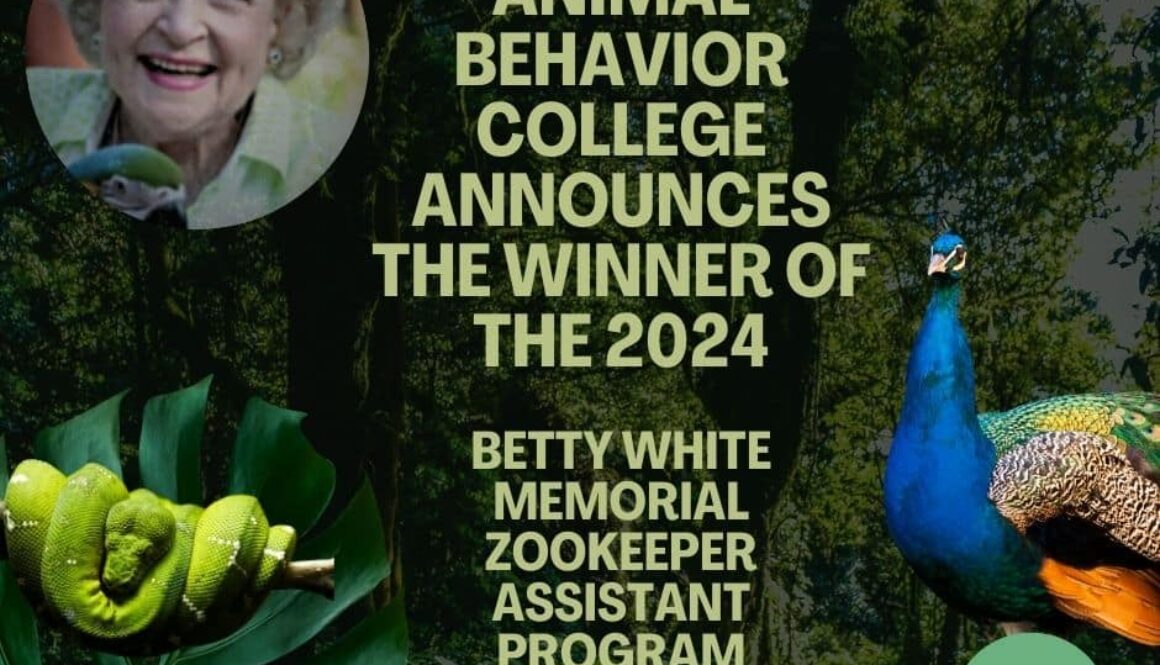
Animal Behavior College Announces the Winner of the 2024 Betty White Zookeeper Assistant Scholarship
Valencia, CA- Wednesday, May 8, 2024– Animal Behavior College (ABC) has announced the winner of their 3rd Annual Betty White Memorial Zookeeper Assistant Program Scholarship.
In 2022 ABC announced a new scholarship in Betty White’s honor after her unfortunate passing: The Betty White Memorial Zookeeper Assistant Program Scholarship. The scholarship is awarded to 1 chosen applicant every year from ABC. Applicants were to submit short essays telling ABC why they are passionate about exotic animals, what caused them to be interested in working in zoos, and how they can make a difference with a Zookeeper Assistant Certification from ABC. Animal Behavior College received many applicants with many impressive and heart-warming essays. All essays were read and reviewed by ABC’s directors and management team, who all voted on their favorite essay for the scholarship winner.
After reviewing many submissions, Animal Behavior College is proud to announce Christopher Joshua Whitworth as the third recipient of ABC’s Betty White Memorial Zookeeper Assistant Program Scholarship. Like Betty White, Christopher has been extremely passionate about exotic animals at a very young age. He is a Wildlife and Forestry Conservationist, a Level 1 Venomous Handler, a certified Master Herpetologist, and works with Wildlife and Environmental Science. He has pursued his passion through the research of the conservation and preservation of Macrochelys Temminckii, or the alligator snapping turtle. He currently works at an AZA-accredited zoological facility in security and hopes to move up to work alongside the keepers there.
This scholarship will give Christopher an opportunity to pursue his drive, commitment, and dedication to the conservation and well-being of all creatures, both great and small.
ABC would like to thank all who submitted their essays and is delighted to award Christopher Joshua Whitworth with ABC’s Betty White Memorial Zookeeper Assistant Program Scholarship. Congratulations Christopher on your scholarship at Animal Behavior College and ABC looks forward to helping you pursue your dream career!
Animal Behavior College’s Zookeeper Assistant curriculum consists of 10 stages covering a wide variety of topics essential for a zookeeper assistant including zoo biology, zookeeper requirements, animal husbandry, animal behavior, animal housing, recordkeeping, safety, and more.
Making a veterinary clinic hum takes a dedicated support staff. Vets rely on their vet assistants, vet techs, and office staff to make sure their furry patients get the quality care they need to live long, healthy lives or to provide life-saving emergency care.
Without question, the jacks of all trades in a vet clinic are the veterinary assistants, who often bounce from duty to duty in every part of the facility. They assist veterinarians and vet techs in a wide variety of ways, and they are everywhere.
At any given time, veterinarian assistants can be found in the reception area welcoming patients and making appointments, in the office filing paperwork, in an exam room helping the veterinarian calm a nervous dog, in the surgery room making sure everything is spotless and sterilized for the next patient, in the kennels checking on post-op patients, or out back walking a puppy.
One thing is certain: vet assistant jobs are never boring!
The essential work done by vet assistants helps vet practices hum along smoothly. The long list of duties a veterinary assistant may perform include:
Cleaning and sanitizing equipment
Feeding, bathing, and exercising patients
Performing basic lab work
Weighing animals
Dressing wounds
Taking vital signs
Administering certain types of medicines
Post-operative care
Disinfecting operating and exam rooms
Clerical work, such as assembling patient paperwork or billing
Animal restraint
Communicating with pet owners
For someone passionate about animals, becoming a vet assistant gives you a chance to be a vital part of a life-saving team.
Vet Assistants Enjoy High Degrees of Job Satisfaction
Vet assistants get to be around animals all the time, but the job can vary depending on where you work. Assistants in a regular veterinary clinic get to know their patients from their first visits as cute, bouncy puppies and adorable blue-eyed kittens. They watch them grow up and play a role in keeping them healthy.
Their days are a mix of routine check-ups and more critical care. While there are the inevitable sad days, the good days outnumber the bad.
Vet assistants in an animal hospital or emergency care center might find life more hectic, but saving lives feels very rewarding.
Being a vet assistant is a good way to get a feel for animal healthcare. Some enjoy veterinary care so much that they go on to pursue a veterinary technician degree, which requires at least two years.
Finding a Vet Assistant Job
With the growing number of pets in this country, there’s a corresponding growth in the number of jobs related to their care, including veterinary assistants. Job growth is projected to be 20% between 2022 and 2032, according to the U.S. Bureau of Labor Statistics. Almost 27,000 job openings are anticipated yearly.
This doesn’t mean it’s easy to land those jobs, though. Even though there are rarely any educational requirements besides a high school diploma or equivalent, it’s a tough field to break into if you don’t have experience working with animals or a vet assistant certificate. There are simply too many people looking for a career with animals to be able to land a job with no skills or training.
If you can, find opportunities to work with animals and get some experience. Look for opportunities to work at or volunteer in local animal shelters, wildlife rescues, boarding kennels, doggy day cares, stables, or other facilities that house animals.
Another good way to get noticed by potential employers is to earn your vet assistant certification. Becoming certified can increase your chance of landing a job faster. After all, vet practices don’t have to spend nearly as much time providing on-the-job training to hires who already know what’s expected of them.
How to Earn a Veterinary Assistant Certificate
Getting a veterinary assistant certificate is not nearly as costly or time-consuming as earning a vet tech degree. You can be certified in less than a year in a program like Animal Behavior College’s online vet assistant course.
Flexible and affordable, Animal Behavior College’s program teaches you everything you need to know in order to work as a vet assistant. It also offers invaluable real-world experience. Once the online part of the course is complete, students get the opportunity to work with a mentor in a local veterinary setting. You may be asking, is there a veterinarian near me?Call us at the number below, and we will tell you which veterinarian you may be paired with.
If you’d like to start a satisfying career working with animals, we’d love to help make that happen. Call us at 800-795-3294 to speak to an admissions counselor.
Don’t forget to visit our gift certificate page here.
A comprehensive vet assistant program provides a straight path to working in animal healthcare. If your heart is set on helping animals, becoming a veterinary assistant is a great choice.
Before making any job move, however, it pays to learn as much as you can. This guide is designed to answer questions you may have about being a vet assistant and what the position entails.
Updated 2025 Statistics & Trends in Veterinary Assisting
Competitive Compensation Across the U.S.
As of January 2025, veterinary assistants in the United States earn an average annual salary of $33,979, with hourly wages averaging $16. Salaries can vary based on location and experience; for instance, in California, the average annual salary is $37,479, while in Florida, it’s approximately $32,280.
Significant Employment Growth Projected
The demand for veterinary assistants is on the rise, with employment projected to grow 19% from 2020 to 2030, much faster than the average for all occupations. This growth is driven by increased pet ownership and a heightened focus on pet health and wellness.
Advancements in Veterinary Training Facilities
In response to the growing need for skilled veterinary professionals, new state-of-the-art training centers have been established to support veterinary assistant education, veterinary technology, and veterinary medicine.
Clarifying Confusion Between Vet Assistants and Vet Techs
Job titles in a vet practice can get a little confusing. While most people understand that veterinarians are at the top of the professional food chain, they tend to use the titles “vet assistant” and “vet tech” interchangeably. The two are completely different jobs, however.
Veterinary technicians function more like nurses and must go to college and complete at least a two-year associate’s degree and be licensed or certified. Their duties correspond loosely to those of nurses in a human healthcare setting. Veterinary technician education is more intensive and focuses on areas like veterinary anatomy and veterinary dentistry. Vet techs are allowed to do more clinical work than vet assistants.
Veterinary assistants are best thought of as the support staff that makes the jobs of veterinarians and vet techs go more smoothly. On any given day they can be doing clerical work, welcoming patients, helping with an exam and preparing rooms. They step in where needed.
Generally speaking, a high school diploma or its equivalent is the only educational requirement for being a vet assistant. That being said, though, it’s to your advantage to look for opportunities to gain experience working with animals and to earn a veterinary assistant certificate.
What Do Vet Assistants Do?
Just because vet assistants don’t have a two-year associate’s degree doesn’t mean they are relegated to cleaning kennels and filing patient paperwork–although there can be a good bit of that.
Vet assistants can:
Check patients in and help soothe nervous patients and pet owners
Weigh animals and take vital signs
Help restrain animals while they are being examined or getting vaccines
Bathe and feed animals
Provide monitoring and care for animals in post-op
Clean and dress wounds
Take lab samples for laboratory animal testing
Give certain medications (controlled substances and painkillers may be off-limits, depending on state regulations)
Provide client education on post-treatment care and proper at-home patient management.
Vet assistants hop from duty to duty. Expect to be on your feet a lot and ready to step in wherever needed!
Depending on the practice, vet assistants may be the first to arrive in the morning to check on patients in post-operative or kennel care and make sure everything is in order for the day before the rest of the staff and the first patients arrive.
What Qualities Do the Best Vet Assistants Have?
A passion for animals and providing great veterinary care are high on the list, but as mentioned, it can be a pretty demanding job, not just physically but emotionally. Not every patient makes it. Saying “goodbye” to pets you’ve cared for throughout their lives is tough.
Communication skills are a must for vet assistants. Being a “people person” is also a plus for a couple of reasons.
You’ll be working with and supporting several other staff members in the veterinary office. Being able to work as part of a team is crucial.
There are always plenty of high-strung, worried pet owners on any given day. Empathy and good people skills are a must.
The best vet assistants are flexible and able to bounce from one task to the next with a high level of competency. Vet assistants hop from duty to duty. Expect to step in wherever needed!
Vet assistants need to be physically strong. Lifting dogs on and off exam tables is part of the job, but so is hauling heavy bags of food, bedding, kitty litter, and other supplies. Each veterinary practice should have its own physical requirements. Make sure you know what is expected of you beforehand so you can commit to the level of strength needed.
Computer skills are a definite plus. Vet assistants often perform a lot of clerical work and billing, so it helps to know your way around a Mac or PC.
Where Can Vet Assistants Work?
Besides veterinary clinics, animal hospitals, and emergency care centers, vet assistants are needed by any facility that houses or cares for animals. Animal shelters and humane societies often need vet assistants, as do research labs at universities and other animal facilities.
In addition, zoos and wildlife rehabilitation centers frequently hire vet assistants, so if your interests lie more in exotic or wild animals, being a vet assistant allows you to care for more than just domesticated animals.
Vet Assistant Salary
If you are concerned about salary–and who isn’t–vet assistants earn a salary on par with many other careers that do not require a degree. Preschool teachers, receptionists, bank tellers and vet assistants all earn an average salary in the mid-$30,000 range.
The U.S. Bureau of Labor Statistics cites the average salary for vet assistants at over $36,000. Some roles such as animal care attendant, veterinary technician assistant, or approved veterinary assistant may offer slightly different pay scales.
How to Become a Veterinary Assistant
As indicated, a high school diploma or equivalency is all that is required by most employers. You technically can be hired as a vet assistant and get on-the-job training.
In reality, it takes a good bit of luck to land a veterinary assistant job without any more experience or credentials than a high school degree. So many people want to work with animals that you’ll be up against job candidates with animal care experience or who have completed an approved veterinary assistant program.
To improve your chances of landing a job, you might want to consider earning your veterinary assistant certificate. Earning a veterinary assistant certificate takes about a year and teaches you what you need to know to begin work in the veterinary field:
How to safely restrain animals so they can receive care
Animal first aid and CPR
How to clean and prepare exam and surgical rooms in a veterinary hospital
How to assist in surgery under a veterinary surgeon
Veterinary-specific pharmacy information
Animal nursing care
Laboratory procedures
Earning your vet assistant certificate tells potential employers you are serious about working in veterinary medicine, know what the job entails, and will need little training.
Finding a Veterinary Assistant School
Animal Behavior College has been training people for animal careers since 1997, and we offer excellent training for would-be vet assistants. Our comprehensive curriculum includes all you need to know to start working in a veterinary setting as soon as you earn your certificate.
ABC even provides real-world experience via our mentoring program known as an “externship.” Once students complete the online portion of the program, they are paired up with a nearby mentor facility to see what a real veterinary clinic is like and to practice newly learned skills.
You can enroll anytime! Just call 800-795-3294 and an admissions counselor can help get you started!
Veterinary Assistant FAQ
Q: What is the difference between a veterinary assistant and a veterinary technologist?
A: A veterinary assistant helps support staff and veterinarians with everyday tasks, while a veterinary technologist typically has a four-year degree and performs more advanced procedures.
Q: Is online veterinary assistant training available?
A: Yes! Many programs, including those from Animal Behavior College, offer online veterinary assistant training that includes hands-on externships.
Q: Can vet assistants work with farm animals or miniature horses?
A: Absolutely. Some veterinary practices and shelters focus on farm animals or offer services for miniature horses, and veterinary assistants play an important role.
Q: What are some career options after becoming a vet assistant?
A: Many vet assistants go on to become animal trainers, licensed veterinary technicians or even veterinarians. Others may work in animal husbandry, animal rescue, or become animal assisted therapists.
Q: Where can I work after completing a veterinary assistant program?
A: Veterinary assistants work in a variety of places including veterinary clinics, animal hospitals, wildlife rehabilitation centers, animal shelters, and even educational facilities focused on veterinary technology and veterinary dentistry.
If you’re passionate about animals and looking to begin a rewarding career, veterinary assisting may be the perfect path for you!
How a Veterinary Assistant Program Can Boost Your Career Prospects in the Animal Care Industry
No Vet Assistant Credentials? No Problem?
If you want to work with animals and are considering a career as a veterinary assistant, you may wonder whether you need any credentials to apply for jobs.
Though it is a medical field, you do not need to have any licensing, certification, or degree to be a veterinary assistant. The only education requirement for becoming a veterinarian assistant is usually a high school diploma.
This is exciting news…until you start applying for jobs, and then it is crickets. No one is willing to give you a chance.
Why?
Because you have no credentials.
Do not let people tell you differently: getting a veterinary assistant certification makes a difference. An attractive vet assistant job candidate either has lots of experience working with animals in some capacity or has a vet assistant certificate proving knowledge of the field. Just showing up with a high school diploma and saying, “I love animals,” does not cut it in a crowded job market.
The Reality of the Vet Assistant Job Market
On the upside, there are plenty of jobs available to qualified applicants, and all signs point to continued growth. According to Forbes, 66% of American homes have pets in 2024. And since 51% of those owners consider their pets part of their family, spending on pets is astronomical. The figure is closing in on $150 billion, with veterinary care claiming a huge chunk.
More pets equal more vets. More veterinarians equal more vet assistant jobs.
Even with more jobs being created, however, there are still lots of animal lovers vying for every single one of them. Prospective employers can choose among qualified job candidates.
Why would they pick someone with no skills, training, or meaningful experience when they could fill the position with a certified veterinary assistant who would require little job training?
Sure, there are some people who get hired with no experience and no job training, and they receive on-the-job training. In reality, though, they are exceptions to the rule. These are competitive jobs. Think how much you love dogs and cats, and puppies and kittens, and want to help take care of them! So do thousands of other animal lovers.
How Do I Improve my Job Prospects?
Getting experience working with animals will help beef up your resume for sure. Depending on where you live, this may be easier for some than others. Rural areas offer opportunities to get experience on farms or ranches or in riding stables. Wildlife rehabilitation centers may also accept volunteer help. Cities may have zoos with volunteer programs (although those are super hard to get into, too). Dog kennels or doggy daycares are also good options.
If you have a challenging time getting your foot in the door somewhere to get experience with animals, or if you have experience and still cannot land a job, enrolling in an online veterinary assistant program could give you the leg up you need.
Animal Behavior College’s online program can be completed in about a year and is more affordable and flexible than attending a brick-and-mortar trade school.
ABC also ensures you get plenty of real-world experience working in a veterinary clinic setting. Once your online work is done, you start on an externship with a mentor at an animal hospital facility near you. Under your mentor’s supervision, you can practice your new skills and get a feel for what it is like working in a veterinary practice.
Once you get certified, you will be able to demonstrate to prospective employers that:
You are serious about a career as a vet assistant.
You have experience in a veterinary facility.
You will have a good grasp of what the job entails and will not need much training.
You have knowledge about sterilizing, prepping exam rooms, lab procedures, animal restraint, and other essential elements of the job.
It’s Time to Get Serious About Your Career
Why waste more time applying for veterinary assistant jobs without any experience or credentials to recommend you? Become the type of job candidate vet practices are looking for! Call ABC at 800-795-3294 to set up an interview today.
If you have recently acquired an adorable, irresistible ball of puppy fluff, or are thinking about acquiring one, you should plan on beginning training at once. Eight weeks may seem young, but the best, more receptive age for puppy training is between two and four months.
Your puppy may seem tiny, but you really cannot start training too young. Like kids, puppies are sponges, soaking everything up and learning quickly. Just make sure to keep training sessions fun and positive–negative experiences or impressions can last a lifetime.
Even at that early age, puppies have that I-want-to-please-my-human thing going on, so you have that going for you!
Serious Business Disguised as Fun and Games
Dogs are naturally fun-loving. Training should be a blast for your pup.
Consider this: even as full-grown adults, working dogs do what they do for pleasure. Canine Sergeant Adam Witherspoon, who has trained hundreds of police dogs, says, “It is a game to dogs. They succeed in a task; they get a reward.”
It is amazing what a dog can learn to do, and it all starts in puppyhood!
“Make training fun! It does not have to be exceptionally long but make it fun for you and your pup each time,” says Animal Behavior College dog training instructor Samantha Jonker.
A focus on fun paired with your pup’s natural desire to please makes it easy to teach obedience basics like “sit” and “focus” — the two most important early lessons. You really want your puppy to be able to put his whole attention on you. Plus, that little pup sitting and looking up at you expectantly with those big brown eyes will melt your heart.
Before You Begin
It is crucial to understand the importance of timing in training. You want to reward your pup the very instant he does what you want. Mark the behavior with a treat or a “Yes!” If your timing is off, though, you risk reinforcing the wrong behavior.
Your pup will quickly learn to repeat whatever behavior earns him a reward, so you will need to think like your puppy. For instance, if he is whining for a treat and you give him one then what has he learned? “If I whine, I get a treat!”
Sit!
This is one of the easiest commands to teach your puppy. While she is standing in front of you, hold a treat above her head so she must look up. As she does, her little rear will sink to the floor and the instant it touches the floor you say, “Yes!” and let her have the treat.
Do not anticipate. Wait until her haunches hit the floor.
Repeat it five or six times with the treat, then try it with just the hand motion (keeping the treat in the other hand to reward her when her butt hits the floor). Keep your tone light and positive.
Repeat this several times in short sessions. By then, she will be associating sitting with being treated and begin to sit a little longer. Now it is time to start adding the cue “sit.”
In adding the cue, it is important to time it as she begins the sitting motion. Again, do not anticipate, but do not wait until her rear hits the floor, either.
Repeat several times, remembering to keep your tone happy and training sessions short!
Socialize Your Puppy
Socialization involves exposing your puppy to new experiences and places and helping him get comfortable with people and animals besides the ones in his home. Do not wait until he is older; the younger he is, the more receptive he will be to accepting something unfamiliar. Just do not throw too much at him at once.
“Socialization is so important, with both other people and other dogs,” says Jonker.” Be sure to give your new pup the opportunity to meet new people and other dogs regularly and reward all good behavior you see.”
Not given that opportunity, your pup may shy away from people or worse, start showing aggressive tendencies out of fear.
“A puppy or beginner group training class is a great place to get some exposure to other dogs and to learn manners,” Jonker adds. A win-win!
Interested in Puppy Training? Are You Asking Yourself, Where Is Their Puppy Training Near Me?
If you would like to learn more about puppy training or are thinking about becoming a dog obedience trainer, Animal Behavior College can help. ABC’s online dog obedience program can teach you everything you need to start your career in about a year.
You will get a great curriculum developed by professional trainers and each student will have a program manager to provide support along the way.
Once your online work is done, you work with a mentor trainer in an externship and volunteer your skills at an animal shelter. That way, you will have plenty of hands-on experience by the time you earn your dog trainer certification.
To talk to an admissions counselor, call 800-795-3294.
Fur, Fins, Feathers, and Fangs: 50 Careers for Animal Lovers
Many people who have a passion for animals would love a career working with them. Whether you are zeroed in on one species, like sea turtles or horses; or whether you have a heart for all creatures, your dream job would let you work closely with animals.
Great news! There has never been a better time to start an animal career, especially jobs that are related to pets. The U.S. Bureau of Labor Statistics projects jobs in animal care and services will grow at twice the rate of other occupations.
The growth in this sector of the economy is driven by the explosive increase in the number of pet owners. This number is projected to keep growing.
Dog walkers and trainers are in high demand right now, and just try getting a grooming appointment–pet salons are booked out for weeks! The demand for pet services shows no sign of slowing. If you want a part-time job and enjoy working with animals, those careers will make great side gigs, too! A solid second income can open many possibilities and make things like home ownership and paying off debt happen much faster! Pet grooming, dog training, and dog walking all offer flexible hours and good money. If you are interested in opening your own business, they are all ideal careers for self-employment.
Preparing for an Animal Career
Some of the following jobs require only a high school diploma; others require at least a bachelor’s degree, and salaries range widely. If you earn a college degree in an animal-related field, your opportunities will be much broader and your salary higher.
However, even if college is out of the question for you there are still plenty of rewarding and enjoyable jobs working with animals. Certification programs are available that provide online training and experience in several animal careers, and these look great on resumes! Animal Behavior College is an outstanding example and has been training people to launch careers since 1998.
50 Animal Careers by Category
The following is a breakdown of animal careers by category, along with education requirements and salary potential.
Agricultural Animal Careers
Rural life is beguiling to many folks, and there are many ways for animal lovers to find employment connected to agriculture.
● Livestock/agricultural journalists write articles for publication on topics related to farming, ranching, and other forms of agriculture. A bachelor’s degree in writing, journalism, communication, or agriculture is usually necessary to succeed. The median income is $82,000.
● Farm managers (or stable or ranch managers) oversee daily activities and manage all aspects of production. They hire and supervise workers and make all decisions related to crop planting and livestock husbandry. A Bachelor of Science in Agriculture or the equivalent is a plus. The median income for farm and ranch managers is $75,760.
● Riding instructors teach people to ride horses and feed, exercise, and groom the animals in their care. No degree is required to work as a riding instructor. The average base salary is $55,664.
● Extension agents have many jobs in a community, but helping farmers is high on the list. They also work closely with community youth in a variety of 4-H programs, many of which revolve around animals. A bachelor’s or master’s degree is required. The average salary for extension agents is $54,847.
● Range management specialists study natural resources and work to protect them by developing programs and standards governing the use of rangelands.
A degree in range management is required. The median salary is $51,206.
● Apiculturists, also known as beekeepers, maintain beehives and harvest honey. No formal degree is necessary to be a beekeeper, but should you want to get a bachelor’s degree in entomology or biology it would be helpful in your work. The average salary is $50,574.
● Animal/livestock breeders use knowledge of genetics to select and breed animals. They take animals’ genealogy and characteristics into careful consideration and keep detailed records. Most livestock breeders have a bachelor’s degree in animal science. The median salary for an animal breeder is $45,320.
● Shepherds tend and herd flocks of sheep. This oldest of professions requires no formal education but comes with a median salary of $43.221.
● Horse trainers train horses in the behaviors required by their intended discipline, such as racing, rodeo, show jumping, dressage, or pleasure riding. The median salary is $39,288.
● Grooms often work in the horse racing industry. They provide daily care for horses, saddle and unsaddle them, organize tack, clean stalls, and equipment, and sometimes help with training. There is no educational requirement to work as a groom. The average salary is $29,147.
Aquatic Animal Careers
Aquatic life is fascinating. There is no end to the unique creatures that dwell below the surface of oceans, lakes, and rivers. Scientists are still discovering new life forms in the depths of the seas. Anyone with an interest in marine life has a wide range of career paths to follow.
● Marine biologists study ocean life. They may do experiments, rescue marine life, and monitor the behavior of aquatic animals. Being a marine biologist requires an undergraduate degree in a scientific discipline such as ecology, aquatic biology, zoology, or animal science. The average salary is $86,203.
● Aquarium maintenance technicians set up, maintain, and service fresh or saltwater aquatic tanks in homes and offices. They may also work in fish hatcheries, aquarium parks, or any place that maintains aquatic life in tanks. There is no formal degree required, but certification is desirable. The median income is $40,199.
● Marine life rescuers help injured or sick animals; animals that have become entangled in nets or garbage; or stranded animals. They aid in their rehabilitation. Entry-level positions require no special degree or certification. Higher-level positions may require a degree in marine or wildlife biology. The wide pay range may reflect lots of room for advancement. The median salary is $55,632.
● Aqua culturists, or fish farmers, raise several types of fish and shellfish for profit or consumption. The minimum education required is a bachelor’s degree. The average salary is $44,489.
● Marine biotechnologists take advantage of the unique array of marine organisms to develop pharmaceuticals, enzymes, and chemicals. This career requires a Bachelor of Science degree, master’s, or, at the pinnacle of the field, a PhD in Marine Science and Technology. The average salary is $132,303.
● Marine mammal trainers work with dolphins, sea lions, manatees, and seals–usually in zoos or aquarium parks. They teach behaviors, feed the animals, and maintain clean, safe water environments. Most facilities want job candidates with life or animal science degrees. The average salary is $33,908.
● Deep sea marine biologists study the organisms that live far below the surface, sometimes in the deepest trenches of the ocean. Most of these jobs require at least a master’s degree. Salary maxes out at $60K.
● Fish biologists do such jobs as monitoring fish populations and fisheries, making environmental assessments for proposed projects, and identifying areas of needed research. A bachelor’s degree is typically required for entering the profession. The average salary is $64,945.
● Aquatic retailers vary in job descriptions; managers, aquarium technicians, and other staff command different salaries. The average salary is $38K.
● Hatchery assistants usually do not need a college degree, although if you aspire to a more advanced position you will need to earn one. Some people enter their career with an aquarium maintenance certification. The average salary for a fish hatchery worker is $49,095.
Pet-related Careers (Non-medical)
Aside from allowing you to spend your time with dogs, cats, and other animals, many pet careers are super flexible and make great side hustles. And if you have been looking for an opportunity for self-employment, one of these careers may be just the ticket!
● Dog walkers enjoy lots of fresh air and plenty of canine interaction. It is a fun career or side gig you can get into without needing a special degree. The average salary is $33,526.
● Pet groomers are in demand as the pet population continues to expand. Groomers help animals look good and feel good by bathing and trimming them, cleaning their ears, and clipping their nails. They do not need a formal education, but it helps to go through a training program to get certified. Like $37,501.
● Animal assisted- or pet therapists use therapy animals – usually dogs and cats – to help people with mental disorders or health issues. Pet therapy helps a wide range of people such as residents in long-term care facilities, cancer patients, and veterans with PTSD. Most hold bachelor’s degrees, and a master’s degree is necessary if you wish to counsel patients. The average salary is $38,056.
● Pet sitters care for animals when their humans are not at home. They may stay in the home or just drop in to monitor the animals, take care of litter boxes, and feed and water pets. They let dogs out to potty and walk them. Basic grooming may be involved. No special education is necessary. It is a nice side hustle if you can work it into your schedule. The average wage is $16 per hour. The median salary for a full-time pet sitter is $33,377.
● Dog obedience trainers are also in high demand these days. They train dogs to follow the basic commands for being good citizens, and they help owners understand how to properly continue training at home. Dog trainers do not have to be degreed or licensed, but certification is recommended. The average salary for a dog trainer is $40,348.
● Cat trainers are called to help curb feline problem behaviors, such as counter surfing, biting and scratching people, and litter box refusal. As with dog training, no degree is required, but certification is encouraged. The average salary is $46,748.
● Animal shelter attendants care for homeless animals waiting for their forever homes. They feed, water, groom, and exercise animals, and keep kennels and cages clean. No education beyond a high school diploma is needed, just a heart full of love for animals. The average salary is $30,522.
● Kennel attendants take care of dogs in a kennel. Duties are similar to animal shelter attendants. Again, no degree is required. The average salary is $28,914.
● Pet store retailers do a variety of jobs, most requiring nothing more than a high school degree. The average salary is $34,745
● Doggy daycare providers offer dog owners an approximation of childcare for canines. No degree is required to operate or work at a doggy daycare facility. The average salary is $29,511.
Careers Working with Wildlife
If wild or exotic animals are your passion, there are lots of careers that allow you to work with them.
● Animal control officers are called in to help rescue hurt, lost, or stray animals, trap animals that are endangering people, and provide first aid to wounded animals. A high school degree is usually required. Average salary is $47,913.
● Zoologists study non-domesticated animals, focusing on behavior, ecosystem, and impact of humans on habit. Zoology and wildlife biology are good degrees to pursue to become a zoologist. The average salary is $54,791.
● Park rangers do not necessarily work with animals, but they have regular opportunities to view wildlife during their job. A formal degree may not always be required, depending on the position. The average salary is $42,977.
● Wildlife photographers take amazing images of animals in their natural habitat, often selling them for publication. Self-employed wildlife photographers do not have to have degrees. Their average income is $42,345.
● Conservation officers, also known as fish and game wardens, help protect wild animals in their natural habitats by enforcing conservation and environmental laws and regulations. They work outside in all kinds of weather. Many states require only a high school diploma. The average salary is $50,144.
● Wildlife rehabilitators care for sick, injured, or orphaned animals. The goal is to release the animals back into the wild as soon as they can function normally in their habitat. Biology or ecology are the most commonly desired degrees. The average salary is $44,859.
● Venomous snake milkers extract venom from poisonous snakes for research and emergency lifesaving procedures. Snake milkers are not simply thrill-seekers; they enter a career with a degree in biology, chemistry, biochemistry, or herpetology. They earn an average salary of $33,609.
● Wildlife advocates seek protection for animals and their habitats. They advocate for such things as species conservation, ocean clean-up, or rainforest preservation. The average salary is $64,945.
● Wildlife biologists study animals both in the wild and in captivity. To be a wildlife biologist requires a Bachelor of Science degree in biology, zoology, or some other natural science. The average salary is $61,173.
Animal Health Careers
Those who want to help animals often lean toward veterinary medical careers, but there are other options.
● Animal massage therapists study animal physiology and anatomy. They use massage techniques to improve the well-being of their patients. You can enter the field with a two-year associate degree. The average salary is $71,679.
● Veterinarians are the animal equivalent of human physicians. They must have a four-year degree followed by another four years of veterinary school. The average salary is $103,260.
● Veterinary technicians work in veterinary clinics and can do certain medical procedures, such as give vaccinations, take, and expose x-rays, and assist with surgeries. They must have an associate’s degree. The average salary is $39,293.
● Veterinary dentists have extensive training in oral surgery, medicine, and dental care for animals. In addition to the regular education required of a veterinarian, they must also do a residency in veterinary dentistry. The average salary is $189,979.
● Animal nutritionists make recommendations for food and diets for farmers, zookeepers, pet owners, and others in charge of animals’ well-being. The job requires a four-year degree in agricultural science, animal science, or related field. The average salary is $54,137.
● Veterinary practice managers oversee clinics and animal hospitals, handling staff, payroll, schedules, and related duties. While a degree may not be required, a management or business degree is excellent preparation. The average salary is $82,725.
● Laboratory animal caretakers monitor and care for animals in a research setting. A high school degree is all that is required but, certification in vet assisting may help secure a job. The average salary is $33,907.
● Farriers care for horses’ hooves, trimming them, and shoeing them, when necessary. No degree is necessary, but an apprenticeship or horseshoeing school can prepare you for your career. The average salary is $36K.
● Kennel technicians maintain a clean facility and provide care for animals, such as grooming, feeding, and exercising. A high school diploma is usually the only requirement. The average salary is $28,701.
Launch Your Career with Animal Behavior College
People ask these questions all the time – Where can I find service dog training near me, where can I find dog training near me, or where can I find pet grooming near me? You need not look any further than Animal Behavior College to learn these traits, and how to teach others these skills.
There are lots of well-paying jobs working with animals, even for those who do not have an advanced degree. If you are passionate about finding a rewarding animal career, Animal Behavior College would love to start on the right track.
With online programs for vet assistants, dog obedience trainers, zookeeper assistants, aquarists, service dog trainers, cat trainers, and pet groomers, we can help you launch your career. To talk to an admissions counselor, call 800-795-3294.
Working as a veterinary assistant is a great way to help animals in need. For someone who has a heart for animals, it may seem like the perfect job, but there are some things you should know about it before pursuing a career. This is one of those jobs where you need to know your strengths and weaknesses. If you underestimate the challenges of working for a veterinarian in a veterinary practice, emergency vet, animal hospital, or other type of facility that takes care of animals, there’s a chance you could fail.
Real Talk About Working as a Vet Assistant
Do vet assistants get to spend a lot of time with cute, furry animals? Of course! And if it were just a matter of being around for well-checks, vaccinations, and spaying/neutering, it would be smooth sailing, emotionally.
But vet assistants see a lot, and I mean a lot. It takes a ton of emotional strength to get through the day, sometimes.
Vet staff watches as animals they’ve come to know and love are euthanized, and it often falls on them to comfort distraught owners. They see animals brought in from the shelter or dropped off by “Good Samaritans” who have been abused, starved, and neglected. Vet assistants can never unsee such things; all that suffering takes a toll.
Even on a day that doesn’t bring that level of trauma, there can still be a lot to deal with. Some pet parents can try the patience of the most professional person. Sometimes the schedule is so crammed full you can’t catch your breath! Not going to lie – it can be stressful.
Veterinary practices are not immune to the staffing shortages that seem to plague most industries these days. Vet assistants can be stretched thin, working long hours and sometimes taking extra shifts to make sure there’s coverage.
Finally, it’s a very physical job. This is not a sitting-around type position. Patients need to be weighed, fed, walked, and monitored; there’s lots of cleaning to be done; and lifting anxious, squirming dogs onto exam tables involves twisting and bending – and they can be heavy!
Oh, and I would be remiss if I didn’t mention the job comes with a lot of accidents to clean up, and some of them will be on your clothes.
If you want an easy job, this is definitely not it.
Fortunately, the Benefits of Being a Vet Assistant Outweigh the Challenges
If you’re still reading this, you may be a suitable candidate for a veterinary assistant career! It may be physically and emotionally challenging, but as you probably suspect, there are lots of benefits.
One of the positives is that there’s a lot of need for vet assistants. 86.9 million American households, or 66%, have pets, and at some point, almost all of those fur babies will need veterinary care. In 2022, the U.S. Bureau of Labor Statistics projected the career is expected to grow by 20% by 2032.
Vet assistants earn a decent living, comparable to other jobs that don’t require a college degree, such as being a receptionist, bank teller, or preschool teacher. Each average is in the mid-$30,000 range. The median vet assistant salary is $34,740. If you like the idea of an interesting job that brings something new every day, being a veterinary assistant qualifies. The variety of animals and people you meet keeps the job engaging. You never know what will walk through the door.
Most vet assistants have a passion for animals, and the fact that they get to help animals every day makes their job rewarding. Being part of a team that keeps animals healthy and saves lives every day makes it a worthwhile career.
And if adorable baby animals are your weakness, you’ll have cuddle opportunities galore! So many puppies and kittens come through for their first shots and well-checks, it never gets old.
Vet assistants rate their job satisfaction in the top 30% of careers. The Career Explorer survey considered salary, job meaningfulness, personality fit, work environment, and skills utilization (in other words, do you make the best use of your abilities?).
You may find you love working in a vet practice so much that you want to advance your career. Getting a vet tech degree takes two to four years, but it comes with a higher salary and the ability to do more medically related tasks than a vet assistant can.
Is Being a Vet Assistant for You?
There’s no way to know until you try it, but if you think vet assisting may be a good career fit, Animal Behavior College can help you get certified in about a year. The program is online, but it also provides real-world experience. Every student must complete 80 hours with a local mentor to complete the program.
While certification is not a job requirement, it can often make employers take notice of you. Lots of people with no qualifications or experience apply, but jobs tend to go to people who know what they’re doing.
An ABC Veterinary Assistant certification demonstrates that you know what the job entails and that you have a lot of hands-on experience and attributes employers appreciate.
For more information on a veterinary assistant career, visit our Vet Assistant Job Information at a Vet Near Me page here, and enroll at Animal Behavior College today!
Animal Behavior College has compiled some top goals for pet owners’ New Year’s resolutions.
Making resolutions to keep your pets happy and healthy for the new year is important and should be at the top of your list of priorities. There are always areas for improvement. It can also be fun to establish New Year’s resolution goals that your pets can maintain as well. These pet resolutions can offer a chance to become closer than ever.
Pet health – Keep an eye on your pet’s health. This would include, but is not limited to, diet, exercise, tooth brushing, yearly checkups, and shots, grooming, mental health, heartworm, and flea & tick meds.
Pet safety – Pet safety is a crucial factor when caring for a pet. These should include pet-proofing your home by having only non-poisonous plants, removing choking, suffocation, or food hazards, and keeping chemicals out of reach. Be sure to pet-proof your yard for dangers as well.
Pet insurance – Pet insurance is a health plan for our pets where the owner pays a recurring fee for veterinary expenses incurred. Most plans are for dogs and cats, although some do offer coverage for other pets as well. These plans cover accident-only, comprehensive, or routine care, depending on the plan that you acquire.
Other items to consider
*Spend more time with them.
*Keep pet tags on and updated.
*Investigate new and updated products that can make life easier for you and your pets.
*Purchase safe toys to keep them occupied, so they don’t get bored.
*Do not leave them alone too often or too long.
*Reduce stress for you and your pets.
*Keep them active.
*Socialize your pets with people and animals.
Dog & cat training -Training can be the most beneficial service you can do for your pet. Training can help with things like teaching your pet to stop jumping on people, learn new tricks, obedience, barking issues, destruction of furniture and clothes, getting along better with other pets and humans, and much more.
If you would like to learn how to train your dog or cat, and even turn it into a career, you will want to check out Animal Behavior College. We have programs in dog training, cat training, service dog training, grooming, aquarium maintenance, and zookeeper assistant.
If you want to learn pet grooming to save money on your grooming costs, and possibly make it a career for extra income, investigate our grooming program.
Give us a call at (800) 795-3294 to answer any questions that you might have on one of our programs, and to get enrolled today!
Antisocial behavior, aggression, or untrainability are among the common reasons that dogs and cats are surrendered to animal shelters every day. In many of those cases, better preparation, education, and dedication by owners may have prevented those pets from being abandoned, but could a change in diet have made a difference? In this article, we will explore the influence that different ingredients and nutrients can have on behavior, look at the new directions this research is heading, and how nutrition can affect the training of dogs and cats.
Nutrition and Survival
As evolution shows, the fittest individuals are the ones that survive and breed, so eating the right things has been an important strategy for survival and success. Animals in the wild will select foods that meet their nutritional needs and will even search for specific items to address or prevent deficiencies. How they are able to identify what they are lacking and how to correct it is still a mystery, but when provided with a wide selection of foods, they will generally consume the right balance of protein, carbohydrates, fats, vitamins, and minerals.
The problem domestic pets can face is when the food provided is not properly balanced and there are no alternatives for them to correct that problem. For instance, a dog fed a diet that is too high in carbohydrates will need to consume more of that food to also meet its protein needs and the excess is then stored as lipids, which can have an influence on health behavior.
It is well established that diet quality and nutrient balance have a significant impact on health and wellbeing, does this affect training? To answer that question, let’s start with some human examples.
Human Observations
There have been several experimental trials undertaken at prisons and detention centers on how behavior is affected by the use of vitamin and mineral supplements. The results have shown a convincing reduction in violence and antisocial behavior amongst inmates receiving supplements when compared with those eating a less balanced diet.
Similar studies have been conducted amongst juveniles with a high incidence of delinquency, yielding similar results. The conclusions being drawn are that consuming the appropriate balance of vitamins and minerals improves brain function and cognition, reducing antisocial behavior and violence.
The role of nutrition in canine behavior is a field that is growing in popularity and interest, but there is currently limited scientific evidence to draw definitive conclusions, even less so for cats. Recently, the effects of protein content on behavior have come under the microscope, but focusing on this alone may lead to further problems.
Proteins, Tryptophan and Behavior…Oh My!
Most canine nutritionists agree that protein levels in dog food have an effect on behavior, but there is a lack of consensus over the nature of that effect. The trouble with focusing on a single nutritional item is that it can lead to imbalances elsewhere, so is there a way to optimize the levels of one nutrient without negative impacts?
The answer may be in reducing overall protein content, and at the same time, adding specific amino acids (the building blocks of proteins) that have been proven to positively impact behavior and well-being. Encouraging results have shown that a diet of low to moderate protein combined with the addition of the amino acid Tryptophan can have a beneficial impact on dog behavior, reducing aggression and anxiety and improving attention span and trainability.
Tryptophan is a precursor to serotonin, a neurotransmitter that improves mood and cognitive function, so reducing levels of non-essential proteins and adding beneficial amino acids may strike the right balance.
What About Cats?
The jury is out on whether we train cats or they train us, but being obligate carnivores makes their dietary requirements more straightforward. Cats need higher protein and fat levels than dogs, and when fed a high-quality diet, require only a few additional nutrients to meet their metabolic needs.
Much of the research into feeding and behavior in cats tends to be focused on how they are fed, rather than what. Being a species with a significant prey drive, having food placed in a bowl twice a day will likely lead to frustration, depression, or acting out.
Hiding food in different locations or using food-dispensing toys can help your cat feel challenged and stimulated, and similar approaches can also help occupy your destructive dogs. A cat that feels stimulated and alert is far more likely to be interested in its surroundings and more responsive to training.
Conclusion
There is anecdotal consensus that nutrition plays an important role in dog and cat behavior and therefore, training. However, this area needs more research before snap decisions and assumptions can be made about what foods are “good or bad”.
Research supports the idea that feeding a high-quality diet that meets nutritional needs has a positive impact on behavior and cognition in humans, as well as a reduction in violence and aggression. It would be reasonable to believe this will apply to dogs and cats as well.
There have been encouraging results with the manipulation of proteins (rather than a simple reduction) on canine behavior which may prove invaluable in improving not only their health and wellbeing but our relationship with them too.
Pets that are alert, healthy, and mentally stimulated will invariably be more responsive to training and positive reinforcement than those whose nutritional needs are not being met, so before deciding that a pet “cannot be trained”, take a look at what they are being fed.
Rating A+ The BBB only accredits the business management of a school, not the quality of the curriculum, or training programs.
STATE LICENSURE AND APPROVAL
Animal Behavior College is a private vocational school approved by the Bureau for Private Postsecondary Education (www.bppe.ca.gov) under the California Private Postsecondary Education Act of 2009 and Title 5. California Code of Regulations Division 7.5. Private Postsecondary Education. The Bureau for Private Postsecondary Education approval means that this institution and its operation comply with the standards established under the law for occupational instruction by private postsecondary educational institutions. Institutional approval is subject to continual review and the institution must reapply for approval every five years.
DISCLAIMER
Please be advised that Animal Behavior College (“ABC”) is the exclusive entity authorized to provide certifications and/or degrees from Animal Behavior College. Moreover, such certifications and/or degrees are only conferred by ABC following a student’s completion of an ABC-administered program. No other entity or individual has authority to confer certifications and/or degrees on ABC’s behalf. Any other entity or individual who attempts to do so is acting without express or implied authority from ABC.
GI BILL® TRADEMARK ATTRIBUTION
GI Bill® is a registered trademark of the U.S. Department of Veterans Affairs (VA). More information about education benefits offered by VA is available at the official U.S. government Web site at https://www.benefits.va.gov/gibill
Animal Behavior College, 27509 Avenue Hopkins, Santa Clarita CA 91355-3910 Contact Us