When looking for a dog trainer in Chicago or Chicagoland, pet parents need to consider several key factors. First, pet parents should carefully consider what their dog training goals are. Are you looking to address vexing behavioral challenges such as housetraining, chewing, jumping on people, stealing food from counters, and excessive barking? Or, are you looking to address more severe issues like aggression, separation anxiety, and phobias? Perhaps you are simply looking to teach your pup to listen to basic commands (AKA cues)?
Once you have a clear idea of your goals, compare them to the experience of the Chicago dog trainers you locate. Not all dog trainers are versed in addressing behavioral challenges. Conversely, some dog trainers are more comfortable working on problem behaviors than in teaching obedience, so it’s essential to seek a trainer whose experience matches your expectations. Locating dog trainers can be as simple as merely typing “Chicago dog trainer” or “dog trainer in Chicago” into your search engine of choice. You can also speak with your veterinarian for a referral to a local trainer. Many pet parents use the resource to locate certified dog trainers supplied by Animal Behavior College.
Animal Behavior College, is the largest vocational school for dog trainers in the United States and has graduated over 17,000 certified dog trainers, including dozens and dozens of dog trainers in the Chicago area.
Some people might wonder if there are any differences between a Chicago dog trainer and dog trainers in other parts of the country. Regardless of where you are located in the nation, you will want to work with a trainer you can relate to and one who uses positive science-based training methods. We also suggest that any trainer you work with adheres to LIMA principles. What is LIMA? According to the International Association of Animal Behavior Consultants (IAABC), “LIMA” is an acronym for the phrase “least intrusive, minimally aversive.” LIMA describes a trainer or behavior consultant who uses the least intrusive, minimally aversive strategy out of a set of humane and effective tactics likely to succeed in achieving a training or behavior change objective.”
While working with a dog trainer that uses humane science-based principles is critical irrespective of where you live, people living in the Chicago area should also be mindful of relevant issues to your location. Does the trainer you are considering have experience training in cold weather? If they offer training classes, do they have a facility if you wish to take classes in the fall or winter? It’s not like you will be able to take outdoor dog training classes in February comfortably. Does your Chicago dog trainer understand the differences in the types of behavior challenges and solutions between those dogs and people living in the city of Chicago and those compared to the surrounding suburban areas? This might seem like an odd question, but there are differences in environments between smaller urban spaces and larger suburban ones. The dog trainer you hire should understand what is needed for the area you and your dog reside.
If you plan to have your puppy professionally groomed when she grows up, you should also show her what to expect at her first grooming appointment. Unless you have a wash-and-wear dog who can get by with just an occasional bath—and you are willing to be the one to give it—you will likely want to use the services of a professional groomer. This is especially true if your puppy has long hair that needs to be styled and clipped. However, your puppy will have to wait until she’s at least 16 weeks old to visit a groomer since most salons require dogs to have all their vaccinations before their first session. In the meantime, you can start preparing your puppy for her first grooming appointment. Doing so will help her feel more comfortable while she’s being groomed, and will make the groomer’s job easier.
Start at Home
To help your puppy, you’ll need to start grooming her first at home where she feels safe. Buy a soft-bristled brush for dogs and a guillotine-style nail trimmer for pets. If your pup has long, silky hair, buy a wide-toothed comb. If you’re able, you may also want to get your puppy used to be being bathed, so buy a quality dog shampoo and conditioner. Last, have a good pair of hair-cutting scissors on hand and some towels.
Begin by teaching your puppy to be touched the way a groomer would touch her. Start by handling her paws, lifting each one and gently massaging it with your hand. Reward her for cooperating with praise or a treat. Do this every day, to all four paws. Once she puppy is comfortable with having her paws handled, you can begin trimming her nails. Use the nail trimmer you bought, and gently snip off just a tiny portion of one nail. Don’t cut much. Right now, you just want your puppy to get used to the sensation of the nail trimmer. Give her a treat after you make a small snip, and then move on to the next nail.
Don’t ask your puppy to tolerate having all the nails on all four paws snipped in one sitting. Just do a few nails to start, and then return to do a few others the next day. You don’t want to overwhelm your puppy with this new experience. A few snips and a treat in each session will leave her with a positive experience of nail trimming. If your puppy has a lot of hair, you may also want to gently clip some of the hair on her feet using the hair-cutting scissors. Trim a little bit off one foot, and then reward with a treat. The next day, do the same with another foot. You want her to gradually learn to accept having the hair on her feet trimmed.
Next, get your puppy used to being brushed. Even shorthaired dogs can benefit from regular brushing, and longhaired dogs absolutely require it. Make sure you are armed with a handful of treats, and start gently brushing her back and sides. If your puppy stands quietly while you do this, give her treats with your free hand to reward her. If she’s like most puppies, she will scoot out from under the brush and try to bite it, thinking it’s a game. If she does this, gently hold her by the collar and give her a few strokes with the brush, then a treat. Eventually, she will learn that standing still and getting brushed not only feels good, it results in a food reward.
Electric clippers can be one of the scariest things about getting groomed for a puppy, so it’s a good idea to get her used to the sound and sensation of clippers before her first grooming appointment. You can gradually accustom her to the vibration of clippers by using a beard trimmer or an electric toothbrush, rubbing the bottom of it around her feet and face. You will probably have to let your puppy get used to the sound of the trimmer or electric toothbrush before you even touch her with it. Do this by turning it on and then giving her treats while the “clippers” hum along in the background. Gradually bring it closer and closer, rewarding her each time she accepts the sound. When she seems comfortable with the trimmer or toothbrush, touch it to her body, praising her at the same time.
Bath Time
Every visit to the groomer comes with a bath, so it’s a good idea to get your puppy used to being washed before someone she doesn’t known does it—and in a strange place, too. Fill your bathtub (or sink, if your puppy is a small breed, image right) with a few inches of lukewarm water. Place your puppy in the water, using a happy voice to let her know this is a good thing. Using a cup, pour water on her body. Avoiding wetting her face at this point; you want to gradually get her used to the idea, and wetting her face the first time out might upset her. Once her coat is wet, massage her with shampoo, continuing to talk to her in a happy, upbeat voice. Follow with a thorough rinsing of clean, lukewarm water by using the cup.
You may want to give treats throughout this process to help your puppy associate being bathed with something positive. Keep treats near the tub or sink, and offer her one every few minutes during the process. Once you’ve rinsed out your puppy’s coat, remove her from the water and towel her dry. Talk to her to the whole time, telling her she’s a good girl.
Even if your puppy is a longhaired breed, she probably still has a short puppy coat that can be dried with a towel or two. But when she grows up and goes to the groomer, her coat will likely need to be dried with a blower. You may want to start getting her used to the blow dryer now so she isn’t freaked out by the sound and feeling of it the first time she goes to the groomer.
Begin by turning on your hair dryer while your puppy is in the room so she can get used to the noise. You can do this by having your puppy nearby while you dry your own hair. Eventually, start bringing the dryer closer to her while it’s on, offering her treats. You can even try letting it blow on her while on the low setting for just a few seconds, and then praising her and giving her treats as a reward. Once she seems okay with having the dryer blowing on her, you can use it to finish drying her off after a bath.
The time and effort you spend preparing your puppy for her first grooming appointment will pay off for you, your dog and your groomer. Your puppy will have less anxiety whenever she goes to the grooming shop, and your groomer will really love working on her.
About the Author: Audrey Pavia is an award-winning freelance writer and author of “The Labrador Retriever Handbook.” She is a former staff editor of Dog Fancy, Dog World and The AKC Gazette magazines. To learn more about her work, visit www.audreypavia.com.
While dog training certification is not a requirement for being a trainer, we believe it is one of the distinguishing features of being a trainer versus being an excellent trainer.
Some parents spend the first four years of their human child’s life to select and gain entry into an elite preschool. While we would never advocate for waiting that long to find a certified dog trainer, we do think that a lot of thought should go into selecting one.
Whether your goal is to teach your dog basic obedience or teach them a specific set of skills, it’s important to choose a trainer who can do these things successfully without traumatizing your dog. Before you hire a certified dog trainer, ask yourself these three questions:
What are my goals for this dog? Identifying your goals will help you identify a trainer who matches these goals.
Which trainers are recommended by professionals and people I respect? Ask for recommendations from professional dog sports competitors, professional organizations, friends and family.
What types of training methods does a trainer employ? Before employing a trainer, find out from them (and others) if they truly use positive, rewards-based training.
Personal Referrals
No where is it more important to look for personal referrals than in the dog training world. People love talking about their dogs and their dog’s certified trainer. Ask around. You will hear everything from “my dog disappeared while under their care with no explanation provided” to “they changed my life, and the life of my dog.”
Look for those who are generally enthusiastic about their dog’s trainers and ask for concrete examples. What type of methods do they use? Is it positive or negative based? Are they training the owners as well as the dogs?
Look for a balance
Behaviorists, vets and trainers are all different things. A behaviorist focuses on behavior. Vets focus on health. Trainers focus on training. If you can find someone who is all three, it’s the trifecta of dog training. But, they’re as rare as unicorns.
Choose a Process
Depending on what you want or need, there are many options available for training. Working with a new puppy and need some guidelines? An online course may be enough to refresh your work with your dogs. Do you have a specific behavior that needs to be fixed? A private class may be needed. Just need to teach your dog basic obedience? Group classes are affordable options.
Online
Classes (group)
Private (individual)
Health Checks
It’s always a good idea to have your dog checked before heading out to any certified dog trainer. Most importantly, your dog should be fully vaccinated before going to any group event.
If you’re dealing with specific behavioral issues, it’s imperative that your dog visit a vet before beginning. Training won’t help a dog stop eliminating in a house if they’re dealing with a urinary tract infection. Training won’t stop your dog from snapping at you when he has a slipped disk. Training won’t resolve your dog’s refusal to enter a house if he’s been injured by a family member. Many behavior issues are resolved much faster through a veterinarian. For the ones that aren’t related to health, you will need a trainer.
Learning Styles
Just like humans, dogs learn and process new information differently. Some learn by doing an action over and again, others are prone to sniffing out a solution, and more. Identify ways to train your dogs by identifying their learning styles.
Positive, Rewards-Based Training: “Research shows that dogs do not need to be physically punished to learn how to behave, and there are significant risks associated with using punishment (such as inhibiting learning, increasing fear, and/or stimulating aggressive events). Therefore, trainers who routinely use choke collars, pinch collars, shock collars, and other methods of physical punishment as a primary training method should be avoided.”
Good Teacher (explains why and how they train, then demonstrates)
Continual education
Respectful
Observe a Class
Do you feel comfortable?
No guarantees
Vaccinations
Problem Behaviors: Many behavioral changes are caused by underlying physical problems, and a proficient trainer may ask you to visit your veterinarian for medical testing.
Understanding Certifications
While certification is not a requirement for being a dog trainer, we believe it is one of the distinguishing features of being a trainer versus being an excellent trainer.
The dog training world is filled with programs, certifications and accreditations. But, what do each of them mean? Here is a short list of common abbreviations seen behind a trainer’s name and title.
ABCDT: An ABC Certified Dog Trainer (ABCDT) In support of ABC’s strategic alliance with The Association of Professional Dog Trainers (APDT) and our commitment to keeping dogs safe from injurious training methods. ABC Certified Dog Trainers understand how to teach new behaviors through luring, shaping, capturing or molding and have mastered the behavioral principles of operant conditioning. They have studied positive reinforcement dog training techniques as their primary training tool, which allows your dog to learn the desired behaviors while keeping that unique spark that makes your dog so special to you.
CTC: The CTC is an advanced, two-year program from the Academy for Dog Trainers. This program discusses dog training as well as behavior. The Academy is known as “the Harvard of Dog Training” and is run by world-renowned dog trainer Jean Donaldson.
IAABC: International Association of Animal Behavior Consultants
KPA CTP means that someone has taken the Karen Pryor Academy Dog Trainer Professional program.
NADOI: National Association of Dog Obedience Instructors (NADOI). The NADOI was established in 1965 and is billed as the oldest certification organization for dog trainers. Certified membership involves a minimum of five years experience in obedience training (with at least with two years as a head instructor), experience working with at least 100 dogs, documenting time spent teaching groups for at least 104 hours or private lessons for at least 288 hours and passing a written essay test. Additional specialty certification areas include Puppy, Novice, Open, Utility, Tracking, and Basic Agility.
PMCT: PMCT means that someone has taken the Pat Miller Certified Trainer course through Peaceable Paws. You can find a list of Pat Miller certified trainers, Peaceable Paws affiliates, and Academy graduates via the Peaceable Paws website (look under trainer referrals).
VSA-CDT means that someone has graduated from the Victoria Stilwell Academy Dog Training program. This is a six-month program and you can find graduates here.
VSPDT means that someone is a licensed Victoria Stilwell Positively Dog Trainer. To be accepted, trainers must have an education and at least two years experience, and be admitted through the process.
If you haven’t, then you can look for people who have CPDT-KA, CPDT-KSA, or CBCC-KA (all assessed by the Certification Council for Professional Dog Trainers) or the PCT-A or PCBC-A (assessed by the Pet Professional Accreditation Board). Again, these are people who have had their knowledge of dog training assessed.
Choosing a trainer is one of the most important things you can do as a dog owner. Make sure your trainer fits the needs of you and your pets. Animal Behavior College graduates are trained to use the Least Invasive Minimally Aversive (LIMA) techniques. Our strategic alliance with The Association of Professional Dog Trainers (APDT) and our commitment to keeping dogs safe from injurious training methods ensure that our graduates are among the most successful trainers.
Petco offers a wide variety of services for our pet parents; from grooming to dog training and many different Veterinarian options, inclusive of Vetco clinics and Vet Hospitals.
With all the different service options we can offer our pet parents to provide everything they need for the health and wellness of their fur babies it allows Petco to provide many employment opportunities for ABC graduates.
Grooming Positions available to ABC Grooming Instructor Program Graduates:
Pet Stylist– This position is available to experienced external candidates. All experienced candidates must complete a 3-breed technical test with a tenured stylist in order to remain in role, which offers a compensation plan that helps drive individual performance and rewards with a robust incentive program. Pet Stylists earn competitive wages plus incentive, along with excellent benefits including Medical, Dental, Vision and Paid Time off for all full-time partners.
Career Advancement Opportunities in Grooming:
Pet Stylist Pro– This role is for Petco partners who have been with the company for a minimum of one year and have reached and maintained great targets. Pet Stylist Pros are offered an enhanced incentive plan with vast earning potential.
Grooming Salon Leader– Those who seek to not only expand their grooming skills but also become strong leaders of their own salon have the opportunity to become spectacular PetcoGrooming Salon Leader. This position is available to experienced internal and external candidates. Although Petco Grooming Salon Leaders still interact with pets via grooming appointments, their primary role is to grow the business, lead and develop their team. In turn, they can grow their salon team’s ability to earn incentives. This team growth mindset is rewarded with a strong incentive plan directly related to the fantastic efforts of the collective team.
Dog Training Positions available to ABC Dog Obedience Trainer Program Graduates:
Dog Trainer- this role is very important as it helps save the lives of pets that attend Petco Positive Dog Training class with our certified trainers. All Petco Trainers become Petco Certified AKC CGC Evaluators that utilize positive reinforcement and adhere to LIMA the Least Intrusive Minimally Aversive approach to working with animals and teach dogs how to be well mannered members of their family. All Petco trainers reduce the risk of dogs being left at shelters due to unwanted behaviors. Our Trainers earn an hourly wage plus incentive from every class sale, and full-time Trainers receive excellent benefits including Medical, Dental, Vision, and Paid Time Off and have state of the art digital scheduling & online platforms to support their business.
Vet Hospital Positions available to ABC Veterinary Assistant Program Graduates:
Vet Hospital Vet Assistant- this role provides excellent medical care to our full-service hospital patients located inside our Petco stores. As a Veterinary Assistant, they will greet clients and patients, schedule appointments, communicate with and educate clients, relay test results to doctor and clients, maintain and update client/patient records. They will also help prepare patients and under supervision of the doctor and/or technician, perform in-hospital treatments for sick patients including giving injectable and oral medications as well as intravenous fluid therapy; keep patients clean, watered, and fed (when indicated and directed by doctor), safely walk canine patients when necessary for elimination.
For more information on any of the exciting opportunities please check us out at https://careers.petco.com/
When I decided to get a dog I did no research; I never wondered about dog trainers near me or even checked to see if there were dog training classes offered locally. Huge oversight! You’ve seen the videos on Facebook: a camera pans around a room full of drifting stuffing and couch pillow carcasses while a voice drones “Who did this? Who ate this pillow? Who made this mess? Who’s a bad boy? Did you do this?” as the camera focuses on a chagrined dog bowing his head in shame. That was me.
Maybe you’ve jokingly commented to a struggling pet owner, “Are you walking that dog or is that dog walking you?” That was probably me.
Or perhaps you know someone who’s every conversation was underlaid with the jacked up barking of a canine air raid siren. That’s me, too.
After a week of chaos, I whipped out my phone in desperation and Googled: Dog Trainers Near Me.
Help! There Are a Zillion Dog Trainers Near Me! How Do I Choose?
I wanted to be cautious in my choice of dog trainers, so I did some reading up on the subject. The relationship between dog and owner should be a delight. Poor training methods can jeopardize that relationship. According to the Preventive Vet, negative reinforcement—or “aversive training methods”—can cause permanent damage. So even though negative reinforcement may work in the short term, the long term effects can be permanent stress for your dog and a pessimistic outlook on life.
Dog and owner should be on the same team. In a positive setting, dogs want to learn and to please. This will not happen if the human in the equation is harsh and domineering. So when checking out those “dog trainers near me” be sure to investigate their training methods.
Can Just Anyone Declare Themselves a Dog Trainer?
The sad truth is yes, anyone can hang out a shingle and call himself or herself a dog trainer. No laws require a dog trainer to be certified. So the onus is on you, the dog owner, to thoroughly research potential candidates. Find out how much experience or education a trainer has. Ask for credentials and certification. Learn about accreditation.
There are great programs out there for educating dog trainers in using positive reinforcement. Once you know what to look for, you should try to find a trainer who has completed a degree in dog training.
Ultimately, you want to choose a dog trainer near you whose goal is to patiently train both you and your pet to work as a team, creating an unbreakable bond between you and your dog.
Dog Trainers Set the Foundation for a Lifetime Partnership
When you commit to owning a dog you commit to a long term relationship. To make the relationship as beneficial as possible for both you and your dog, there should be a strong foundation of trust and affection. Learning how to reinforce good behavior and instill in your dog an unshakeable response to commands will result in a lasting partnership in which you experience a maximum of joy and a minimum of frustration, and your dog feels loved and secure. A well-trained dog is a secure, optimistic, and obedient companion for life.
Dogs do want to please their humans, and it’s our responsibility to teach them what behaviors are appropriate. It’s worth taking a little time to do the research and find the best dog trainer in your area. The investment will pay dividends for a long time to come.
Becoming a successful dog trainer demands more than just a love of dogs. The field requires many personality characteristics, not the least of which are unlimited compassion and patience. You must be good with both people and dogs, and strong teaching and communication skills are essential. For instance, to succeed in teaching a command (AKA “Cue”) , you have to be able to break the skill up into understandable components and convey them clearly to both pet and owner. “A secret about dog training is that most dog trainers don’t train dogs. They train people.” American Kennel Club
Without strong people skills, the love you have working with animals amounts won’t reach its full potential and you may find yourself limited in your ability to help them. Owners must be able to trust you and feel confident that you have the knowledge and skill to help them strengthen the bond with their pet. The owner also needs to believe you can assist them in teaching their beloved dog to become a well-mannered, reliable companion who will follow your cues in the midst of a distracting environment.
What do Dog Trainers Actually Do?
“Hero” is not too strong a word for the person who achieves what a great dog trainer can achieve; they are heroes to both dog and owner, building an invaluable bridge between them. Trainers help grow the bond between human and animal while developing solid life skills for the dog.
Dog trainers have to be able to work with animals of varying ages. Training a puppy can prevent the development of negative behaviors and provide lifesaving skills. For example, an immediate and unshakeable ability to respond to the command “Come!” can spare a dog many dangerous encounters.
60% of dog owners contact a dog trainer for assistance in addressing normal but unwanted behavior challenges. These include; chewing, digging, jumping on family and guests, running out of doors or gates, stealing food from counters or trash, excessive barking and house soiling. Dog trainers can provide vital information and treatment programs to help owners alleviate or eliminate these kinds of behaviors.
Most owners contact trainers with various requests with dogs between the ages of 8 weeks to 3 years.
Sometimes, dog trainers are called in to help manage the behavior problems of older dogs. These might be recently acquired shelter dogs suffering from fear, or they might be longtime pets who have developed unwanted behaviors. Helping adult dogs overcome issues like fear/shyness or separation anxiety can be highly rewarding.
What can also be rewarding is the tangible differences a dog trainer can make in the lives of dogs and the people who love them. This career can be very interesting as every case a dog trainer works on is slightly different than the one before.
In some parts of the country, NYC, LA, SF, Chicago dog trainers can and do earn significantly more than the median. For example, in Southern California a huge area extending from Ventura to the Mexican border and encompassing Los Angeles and San Diego, dog trainers often charge between $45-95 per hour.
In addition to a good salary, dog training offers wonderful flexibility and career potential. If you just want a supplemental income in your free time, dog training allows you to arrange your work around an existing schedule. Some dog trainers strike out on their own, creating great small business opportunities for themselves. Others choose to work for stores such as Petco. How far you take your career is really up to you.
Certainly for someone just starting out. Simply put there is a tremendous amount to learn about behavior and how to apply behavioral principles in a positive fashion to modify/teach behavior. Aside from the academic requirements, experience is key. Good schools combine both theory and hands on experience. So, while it is possible to become a dog trainer and not attend a school for dog trainers, aspiring dog trainers are well advised to consider one as they dramatically increase their chances to succeed as a professional dog trainer.
Are certifications important?
Dog owners have become savvy shoppers! They understand that a certified dog trainer has reached the standard required to obtain the certification granted. Certified dog trainers stand out from those who haven’t been certified. The ABCDT certification awarded by Animal Behavior College is the most popular certification with over 14,000 ABCDT’s in North America. The CPDT-KA offered by The Certification Council for Professional Dog Trainers (CCPDT) is another highly respected and sought-after certification. The CCPDT is an independent certifying organization.
Probably now more than ever, people appreciate the power animals have to soothe our souls. Those of us who live with dogs and cats know how having a warm kitty in our lap or having a dog’s silky ears to stroke helps make us feel calmer and more able to cope with life.
The healing magic that animals provide is no secret to health care professionals, who often utilize the calming presence of dogs to help patients heal. These specially trained canine angels are among the therapy dogs we celebrate on National Therapy Animal Day on April 30th.
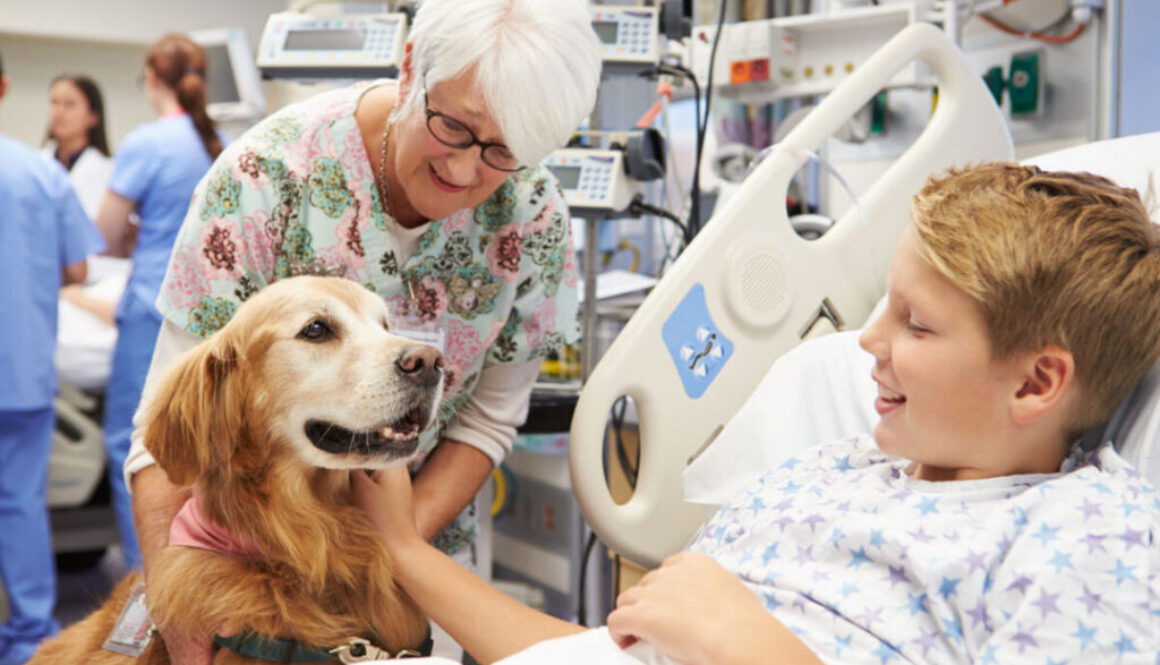
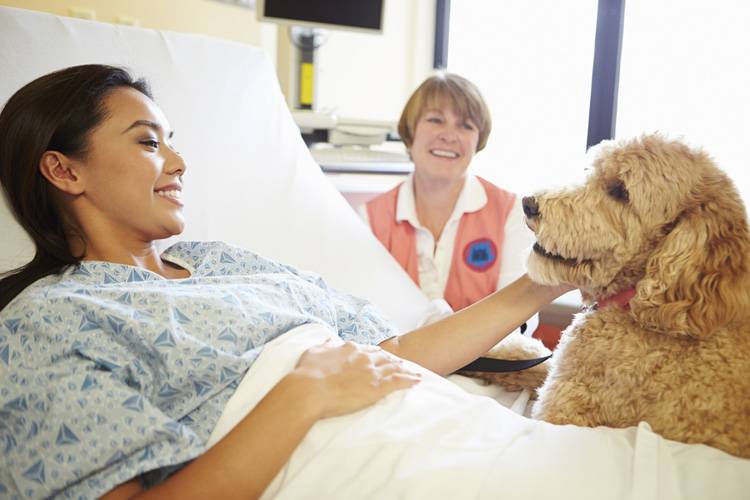
Therapy dogs provide help to people in all kinds of stressful situations. Nursing homes and hospitals are among the most common places visiting by therapy dogs and their handlers, but they also can provide comfort in a number of other settings.
What They Do
Therapy animals are amazing creatures. I know because I had one. My Pembroke Welsh Corgi, Nigel, was certified by Therapy Dogs International, and was authorized to visit hospitals and nursing homes.
Nigel’s very first therapy dog visit was to see my husband, Randy, who was in the hospital being evaluated for epilepsy surgery. Randy was bedridden and had a series of electrodes implanted in his skull. He had a wad of wires coming out of his head attached to a machine on the wall. It was a scary sight for anyone, let alone a dog. But Nigel’s training kicked in when he saw Randy in that bed. Instead of his usual jovial self at seeing his daddy, he was careful and subdued. I placed Nigel on Randy’s lap, and he lay there quietly while Randy rubbed his ears.
After visiting Randy, I took Nigel down to the waiting area where people were gathered while their family members were undergoing surgeries. We walked among the men, women and children, and saw their faces light up as we approached. Only a couple of people didn’t seem interested in petting Nigel. The rest reveled in their happiness at visiting with the cute Corgi and forgot their worries, if just for a moment.
This is the magic of therapy dogs!
Whatever the situation, whether a person is in the hospital recovering from an illness or permanently bound to a wheelchair, their problems are momentarily forgotten when they feel the love and attention of a therapy dog.
After the mass shooting at the Washington Navy Yard in Washington, D.C., where 12 people were killed in 2013, in the days following the incident, therapy dogs paid visits to the Department of Defense employees who worked there. Co-workers of the slain and wounded were extremely traumatized by the events of that day. In response, an all-volunteer organization called HOPE Animal-Assisted Crisis Response provided certified therapy dogs on the grounds so employees returning to work after the shooting had a way of receiving some comfort. Many were suffering from post-traumatic stress as a result of the event, and seeing the dogs helped calm their frazzled nerves. The dogs also helped some people talk about what had happened, enabling mental health professionals on site to provide some assistance to employees who needed help dealing with this horrific event.
Therapy Dog Qualifications
In order to do therapy work, dogs and other animals need the right kind of temperament. They must love people, but also be calm and trainable. That doesn’t mean they shouldn’t be enthusiastic about meeting new people, but they need to be gentle, and sit or stand quietly while being petted. Any type of aggression, even toward other dogs, disqualifies a dog for therapy work. Prospective therapy animals also need to be well socialized, and be able to handle being around objects like wheelchairs, canes, walkers and other types of medical equipment without showing fear or aggression.
Most pet therapy groups also require that dogs be certified by a therapy dog certification organization before they can visit people in need. The American Kennel Club (https://www.akc.org/sports/title-recognition-program/therapy-dog-program/therapy-dog-organizations) currently endorses five organizations for therapy dog certification: Therapy Dogs International, Alliance of Therapy Dogs, Pet Partners, Love on a Leash, Bright and Beautiful Therapy Dogs and Pet Partners.
These therapy dog associations require dogs to pass a certification test, which confirms that the dog has the training and temperament to do the job of a therapy dog.
Learning Basic Obedience First
Obedience training is the first step in getting a dog ready for therapy work. In order to earn the therapy dog certification, the dog must know how to sit, stay, come, lay down and walk nicely on leash when asked. These are behaviors that dogs need to know to be able to perform well as therapy dogs. Acting like a good canine citizen is imperative since they will be out in the world meeting new people, many of who may be sick or disabled.
Start Therapy Dog Training
Once a prospective therapy dog learns basic obedience, he next needs to learn to be around wheelchairs and other medical equipment, to sit quietly while being petted, to be calm around other dogs, jump up on a bed when asked, and ignore food when told to do so, in addition to other behaviors. Whether your dog can master these tasks will depend a lot on his inherent temperament, as well as his training.
You can find training and certification classes for therapy dogs at canine training facilities and dog training clubs around the country. Classes usually run from six to eight weeks, and will help both you and your dog learn how to provide canine comfort to those in need.
Getting Involved
After your dog has earned a therapy dog certification from a reputable organization, your next step is to get involved with a therapy dog group that regularly pays visits to people in need. Regional therapy dog organizations make arrangements for therapy dogs and their handlers to visit places that appreciate canine visitors. Some clubs focus on veterans’ groups and nursing facilities, while others get involved with library programs dedicated to helping children learn to read.
One group, 4 Paws of Love, is an all-Poodle pet therapy organization based in San Diego, Calif. They visit children in schools and libraries, college students who need stress relief, people in memory care and retirement facilities, hospice care patients and the developmentally challenged. Another group, Bright Spot Therapy Dogs in western Massachusetts, used all breeds and mixes to visit psychiatric facilities, rehabilitation centers, senior centers and hospitals, and even participates in reading programs for children. In the Houston, Tx., area, Smiles and Fur Friends Houston pet therapy program involves therapy dog teams making monthly and one-time visits to nursing homes, assisted living facilities, events for special-needs children and adults, schools, libraries, universities and hospitals.
If you and your dog would like to get involved in therapy dog work, visit one of the AKC recommended organizations for more information on training and certification. Search online for a pet therapy group in your area, or contact a local hospital for a referral to a group near you.
Police dogs have their own special day this month (National Police Dog Day is on May 15), and it’s easy to see why. Working dogs whose job it is to help law enforcement protect the public are among the most important canines in our society.
Scientists aren’t sure if dogs were originally domesticated for their guarding abilities (it could have been their hunting skills instead), but whatever the reason, it didn’t take long for ancient humans to start relying on the dog’s fierce instinct for protection.
History of Security Dogs
The ancient Romans were one of the first cultures to use dogs for security. A tour through the ruins of Pompeii, the ancient Roman city destroyed by a volcano in 79 AD, reveals evidence that guard dogs protected many of the homes in the city.
During the Middle Ages, dogs were used for law enforcement in parts of Europe, mostly to hunt down criminals. Bloodhounds were preferred in Scotland because of their superior ability to track by scent.
In the late 1800s, dogs started to become known as valuable partners in police work. London police used Bloodhounds to search for Jack the Ripper in 1888, while other dogs accompanied British police on their beats.
The Start of Police Dog Training
The first formal training of police dogs began in Belgium in 1899. The success of this program brought attention to the valuable help dogs could provide in security work. By 1910, the Germans had made police dogs a common site in cities throughout the country. They chose the German Shepherd as their breed of choice, and the first police dog training school was opened in 1920 in the town of Greenheide.
Dogs didn’t become part of police work in the United States until the 1970s. Now, canine officers are common in police forces throughout the U.S. They are also used by the U.S. military for patrol and detection work, and the Central Intelligence Agency (CIA) for finding and apprehending criminals.
Police dogs are usually trained to perform one or two special functions, depending on their breed and temperament:
Apprehension and attack — Dogs trained in apprehending and subduing suspects work alongside law enforcement officers in cities around the world. German Shepherds, Belgion Malinois, Belgian Turveren Dutch Shepherds, Doberman Pinschers and Giant Schnauzers are most commonly used for these tasks.
Search and rescue —Dogs trained in search and rescue can locate suspects or search for missing people. They are used in police work to help find escaped prisoners, fugitives and lost or missing at-risk people. Labrador Retrievers are commonly used in search and rescue, along with Golden Retrievers, Bloodhounds, Belgian Malinois, Dutch Shepherds, Giant Schnauzers and German Shepherds.
Detection — Detection dogs specialize in sniffing out drugs and explosives. They do their job at border crossings, airports and shipping facilities. The breeds most often used for this work are German Shepherds, Labrador Retrievers, Belgian Malinois, Dutch Shepherds, Basset Hounds, Beagles, Spring Spaniels and Giant Schnauzers. Other dog are sometimes used for detection work, like Border Collies, German Shorthaired Pointers and mixed breeds.
It can take years to train a highly skilled police dog. All working dogs start with basic obedience training and then go on to more specialized training, depending on the particular work they are destined to perform.
Most police dogs live with their handlers, and are treated like family pets when they are off duty. They often form strong bonds with their handlers, and are considered important partners in maintaining law and order by police officials around the world.
How smart are dogs? If you ask any canine parent, they’ll tell you “pretty darn clever!”
Of course, like parents of human kids, pet parents are prone to exaggeration, so you might have a hard time taking their word for it. If you are familiar with the different kinds of tasks trained service dogs can do, you may have a more balanced assessment of their capabilities.
Scientists have spent generations studying canine intelligence.
What does it mean to be a “smart” dog?
Before we can really answer the question of canine intelligence, we have to define what it means to be “smart.” The dictionary tells us that intelligence is defined by “the ability to acquire and apply knowledge and skills.”
By that definition, if you can learn anything at all, you’re an intelligent creature to some degree. However, we don’t look at someone who learned how to use the bathroom and say, “Wow, that guy is really smart!” We associate intelligence with the ability to master complex skills and solve.
So, when we set out to answer the question of canine intellect, we can’t really ask ourselves, “How fast can a dog learn to go to the bathroom outside?” We have to look at how well they can solve problems on their own. One has to do with training through repetition, which is something that nearly every creature can master given enough time. The other has to do with genuine intelligence.
Just how smart is the average dog?
Now that we have a good idea of what it means to be a smart dog, we can really dive into the answer to the original question. It gets a little tricky here because there are studies that say dogs are smarter than we ever knew as well as those that say they’re not as smart as we originally thought. Lost yet? Here’s the thing about studies, for every one that says A, there’s at least another that says B.
I will say this, the 2018 study that came down on the side of “not all that smart” was a bit skewed. They pitted dogs against chimps, which is kind of like pitting oranges against apples. They’re two completely different creatures who express intelligence in completely different ways. Still, I mention the study because it provides a bit of balance.
As a dog lover and pet parent to what I think of as a highly intelligent breed, I much prefer the numerous studies that lean towards “smarter than we thought.”
One ongoing study done by the Duke Canine Cognition Center (part of Duke University) shows that dogs have a “rich understanding of their world, which allows them to be flexible problem solvers.” Researchers have studied both domestic and wild dogs from all over the world. Even after 15 years, they admit that they’re only just scratching the surface of canine intelligence.
Brian Hare, director of the Duke center, explains that one way of measuring intelligence is by looking at how well an animal has managed to survive and increase its numbers. He says that the dog is “…arguably the most successful mammal on the planet besides us. Dogs have spread to all corners of the world, including inside our homes and in some cases onto our beds. While a majority of mammals on the planet have seen a steep decline in their populations as a result of human activity, there have never been more dogs on the planet than today.”
If simply being able to survive and reproduce made one smart, then mosquitoes and cockroaches would be considered downright brilliant. So, we’re back to looking at how well they solve problems.
I’ve seen their problem-solving skills in action first hand more times than I can count. For example, when I was a child, I had a German Shepherd who would stop at nothing to come find me outside. He not only learned how to turn the handle on the front door, but even how to use his teeth to unlock it!
When it comes to research on the problem-solving skills of dogs, no one has studied it more fervently than Stanley Coren, author of over a dozen books on the subject. Coren claims that dogs are “among the most intelligent animals and can rival apes and parrots for their ability to understand language.”
Throughout his studies, he’s found that some dogs can understand 200+ words and master basic counting skills. He even used tests designed for young children to prove it!
So, as you can see, dogs really are pretty smart! However, Coren and other researchers have found that some breeds show a bit more intelligence than others. Keep reading to discover the top 5 smartest breeds.
Top 5 Smartest Dog Breeds
These top 5 smartest dog breeds are considered the “most trainable,” making them ideal for those who need a working dog, such as a service dog, a police dog, or even a helpful canine farmhand.
Border Collie
Bred for herding sheep, this dog consistently ranks as THE most intelligent breed. My aunt’s Border Collie was capable of learning the names of every single one of his toys and knew how to turn on the TV using the remote. He loved watching certain shows and knew what time they came on!
Poodles
Dog behaviorists rank the poodle as a very close second to the Border Collie, and he’s a popular choice for service dog work. Training is typically a breeze, and they excel at everything from agility coursework to tracking work. If you’re looking for the most intelligent small dogs, you’ll be happy to know that all Poodle sizes are equally smart.
German Shepherd
There is a very good reason that this breed is chosen for police work more often than any other breed: they are not only exceptionally intelligent and easy to train, but also able to quickly adapt to new situations. They can easily handle just about any job given to them.
Golden Retriever
The 3rd most popular dog in the United States ranks #4 as the most intelligent. Their trainability comes mainly from the fact that they are so eager to please their families, making them masters when it comes to tasks that require complete obedience.
Doberman
Forget that image of a snarling junkyard dog that comes to mind when we think about the Doberman! These dogs are loyal, playful, and eager to please. Like the Golden, it’s that last part that makes them able to master obedience training quickly and easily.
As the AKC points out, though, these dogs can be a bit stubborn and pushy, so it’s important to socialize and train them at an early age.
If your dog isn’t on the list of the smartest dog breeds, don’t feel bad. The rankings are determined primarily by trainability and not overall problem-solving skills. Some breeds are incredibly intelligent, yet their independence makes them a challenge to train.
My Pharaoh Hound, for instance, is definitely the smartest dog we’ve ever had, but she has an independence streak is a mile long. Her breed excels in reward-based training, but even the most obedient Pharaoh Hound will completely ignore you when they are hunting prey. Basically, they have zero recall when off-leash, and many have been lost forever after darting out the front door after a stray cat.
Another thing to remember, like people, every dog displays its own unique blend of intelligence. Many factors come into play, including socialization, training, and even just how you treat your dog. So, it’s entirely possible to have a brilliant dog that doesn’t make the top 5, top 10, or even the top 100 smartest breeds.
So, just how smart are dogs? As the Duke University Canine Cognition Center explains, you can’t really rank their intelligence on a number scale, but the research speaks for itself: they’re pretty darn smart!
About the Author: Nicole Etolen is a writer and editor at DogVills.com, a site dedicated to helping both new and seasoned dog parents lead the very best lives possible with their canine companions. She’s also a pet parent to a highly intelligent Pharaoh Hound.
Have you ever wished you could help all the homeless dogs and cats in the world? Since you are just one person, it’s impossible to save them all. However, you can make a huge difference in the life of at least one animal by adopting a shelter pet.
April 30 is National Adopt a Shelter Pet Day, which has been set aside to call attention to the plight of millions of unwanted dog and cats in the U.S. Although the efforts of animal welfare advocates over the last 10 years have reduced the number of homeless pets euthanized every year in this country, the numbers are still far too high: 1.5 million dogs and cats are put down in American shelters each year because they are unwanted, according to the American Society for the Prevention of Cruelty Animals.
In addition to spaying and neutering, and practicing responsible pet ownership, one great way we can reduce those tragic numbers is to adopt. Giving a home to a dog or cat from your local shelter means one less homeless pet facing euthanasia.
Why Adopt?
Although reducing the number of pets languishing in shelters is a great reason to adopt a shelter pet, there’s one other really good reason: Dogs and cats adopted from shelters can make terrific pets! Here are just a few reasons why:
Many shelter pets are full-grown. While this may not seem like an advantage at first, it is if you think about it. Have you ever had a puppy you had to housetrain, and who wanted to chew up everything in your house? Have you ever had a kitten hanging from your drapes and attacking your ankles when you walk by? Adopting an adult dog or cat eliminates these issues and more. Adult dogs and cats are usually more relaxed and experienced in life. The vast majority of shelter dogs are leashed trained, and some even know basic commands. Many are housetrained too. Adult cats that come from shelters usually know how to use a litter box, and have outgrown the “kitten crazies.”
Puppies and kittens too! If your heart is set on getting a puppy or a kitten, a shelter is the place to go. Most shelters have an abundance of young animals needing homes. While it’s easier for puppies and kittens to get homes than adult dogs, shelters still need people willing to take on the work involved in raising a young dog or cat.
Shelter pets make great family members. It’s a myth that dogs and cats in shelters are there because they have behavior problems. The vast majority of shelter pets end up in this situation through no fault of their own. In fact, many shelter dogs are already housetrained and leash trained, and most shelter cats reliably use a litter box.
Shelter pets are grateful. If you have ever rescued a dog or cat, you know what gratitude looks like. When you provide a home to a pet that has spent even a short time in a shelter, that pet knows she’s been rescued. The love and devotion you’ll receive from your shelter pet will make all your efforts worthwhile.
Remember supporting sanctuaries and rescues is also another way to help prevent pet homelessness. Please take a moment to visit one of ABC’s favorite rescues Best Friends Animal Society, who will be hosting an adoption event Pay it Forward from April 26th-28th.
How to Prepare for Your First Rescue Pet
By Sandy Robins
Congratulations on deciding to adopt pet. Being a pet parent is truly a very rewarding experience; there is nothing like the love and companionship of a fur kid. And, as with welcoming any new family member into your home, it’s important to do some advance preparations to ensure the transition is a positive experience for all concerned.
Being in a shelter/rescue environment can be a very daunting and fearful experience for any pet whether the stay was a few short hours, weeks, even months. It’s important to try and get as much background information about your new family member as possible from the shelter.
For example, if a pet has suffered abuse, they may be fearful of men if the abuser was male. If they have been starved, they may tend to want to over eat. Shelters have relationships with veterinarians, dog trainers, cat trainers, and behaviorists who can offer advice with regard to such issues and help you and your fur kid get to know one another and others in the household and build relationships based on trust. Similarly, if the dog or cat you are adopting was the only pet in its previous home, it may be more comfortable in a home with no other pets.
So, don’t be shy to ask questions and seek advice, and, even help down the road if its needed.
SECURITY ALERTS
Preparing to bring a rescue pet into your home requires preparation. Often a shelter will do a home visit to ensure that it’s a secure place for a new pet. A good place to start is by checking the security of your home. This means checking things from window screens to ensuring there are no holes in the fence.
Rescue pets do not leave a shelter until they have been spayed or neutered and microchipped. But the onus is upon you to ensure the information is given to the microchip company is up to date.
SETTLING IN
When you bring your new family member home for the first time, allow them time to acclimatize before inviting friends over for a meet and greet. Cats settle better if first sequestered in one comfortable room for a few days before being allowed to explore under supervision.
CHECK LIST
Having all your basic pet essentials in place will allow your new friend to quickly settle down and know this is a forever home. Here’s a checklist of essential items to shop for in advance.
CRATES
By nature, all dogs have a den instinct and a crate simulates this basic instinct and allows your dog to have its own personal space. For a young puppy, it’s a good idea to buy a matching cushion as well as foam bumpers for the sides, just like you would put in a baby’s crib.
FOOD AND WATER BOWLS
There is no shortage of stylish food and water bowls that will slot in beautifully with your home décor. Stainless steel, glass or ceramic bowls are hygienic because they as dishwasher safe and thus easy to keep clean. A drinking fountain is an excellent idea to ensure that your pet has a constant supply of fresh running water.
BEDS
Both dogs and cats like to have a personal bed even if they will cuddle in with you.
COLLARS
A soft nylon with a quick-release clasp is an ideal starter collar for a young puppy. Because puppies grow in leaps and bounds, pet owners often find themselves adjusting the collar on a weekly basis. You can splurge on something fabulous for an adult dog. Similarly, its good idea for cats to wear a collar with an ID tag as well as a tag with the microchip information.
HARNESS AND LEASH
Invest in a leash that matches the collar. And consider a soft harness to complete the ensemble. Attaching the leash to the harness avoids any pulling and tugging on the neck area and gives you better control when you are out and about.
CAR RESTRAINTS
In many states it’s now the law to ensure your dog is restrained in a moving vehicle. If you don’t plan to have a car crate, it’s essential to purchase some other form of restraint. There are lots of options. Be sure to purchase one that has been safety-tested.
TOYS
Just like kids, a dog or cat can never have too many toys! For dogs, be sure to purchase action, distraction and comfort toys. Cats love wand toys so they can pounce and play and, of course, love everything that includes catnip.
GROOMING TOOLS
Take advice on basic grooming tools in terms of your dog or cat’s coat type. A grooming glove covered with a knobby rubber finish or a special hair-grabbing material is always useful. Make sure your grooming box includes a good pair of nail clippers.
LITTERBOX AND LITTER
Always be sure to purchase a spacious box and place is away from a high traffic zone in the home.
Spending lots of quality time with your new rescue pet helps them adjust. Everything, from preparing and serving a meal to grooming are great bonding experiences.
Rating A+ The BBB only accredits the business management of a school, not the quality of the curriculum, or training programs.
STATE LICENSURE AND APPROVAL
Animal Behavior College is a private vocational school approved by the Bureau for Private Postsecondary Education (www.bppe.ca.gov) under the California Private Postsecondary Education Act of 2009 and Title 5. California Code of Regulations Division 7.5. Private Postsecondary Education. The Bureau for Private Postsecondary Education approval means that this institution and its operation comply with the standards established under the law for occupational instruction by private postsecondary educational institutions. Institutional approval is subject to continual review and the institution must reapply for approval every five years.
DISCLAIMER
Please be advised that Animal Behavior College (“ABC”) is the exclusive entity authorized to provide certifications and/or degrees from Animal Behavior College. Moreover, such certifications and/or degrees are only conferred by ABC following a student’s completion of an ABC-administered program. No other entity or individual has authority to confer certifications and/or degrees on ABC’s behalf. Any other entity or individual who attempts to do so is acting without express or implied authority from ABC.
GI BILL® TRADEMARK ATTRIBUTION
GI Bill® is a registered trademark of the U.S. Department of Veterans Affairs (VA). More information about education benefits offered by VA is available at the official U.S. government Web site at https://www.benefits.va.gov/gibill
Animal Behavior College, 27509 Avenue Hopkins, Santa Clarita CA 91355-3910 Contact Us

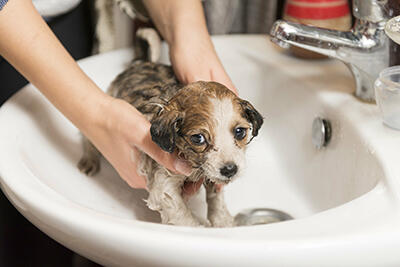 Every visit to the groomer comes with a bath, so it’s a good idea to get your puppy used to being washed before someone she doesn’t known does it—and in a strange place, too. Fill your bathtub (or sink, if your puppy is a small breed, image right) with a few inches of lukewarm water. Place your puppy in the water, using a happy voice to let her know this is a good thing. Using a cup, pour water on her body. Avoiding wetting her face at this point; you want to gradually get her used to the idea, and wetting her face the first time out might upset her. Once her coat is wet, massage her with shampoo, continuing to talk to her in a happy, upbeat voice. Follow with a thorough rinsing of clean, lukewarm water by using the cup.

 After your dog has earned a therapy dog certification from a reputable organization, your next step is to get involved with a therapy dog group that regularly pays visits to people in need. Regional therapy dog organizations make arrangements for therapy dogs and their handlers to visit places that appreciate canine visitors. Some clubs focus on veterans’ groups and nursing facilities, while others get involved with library programs dedicated to helping children learn to read.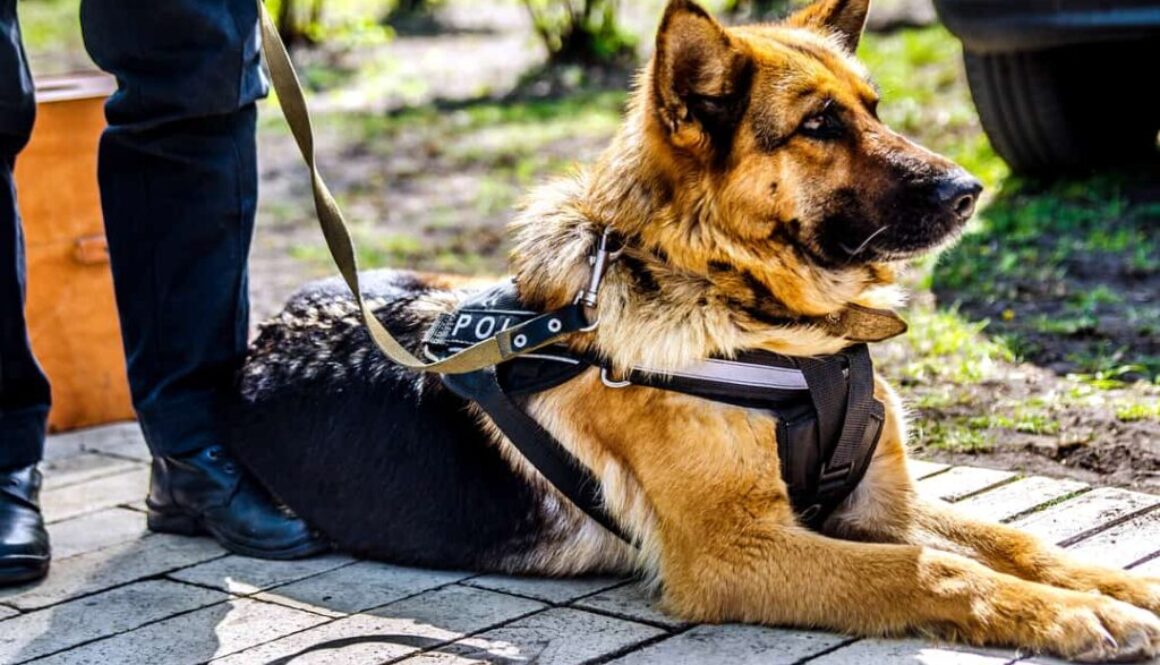


 understanding of their world, which allows them to be flexible problem solvers.” Researchers have studied both domestic and wild dogs from all over the world. Even after 15 years, they admit that they’re only just scratching the surface of canine intelligence.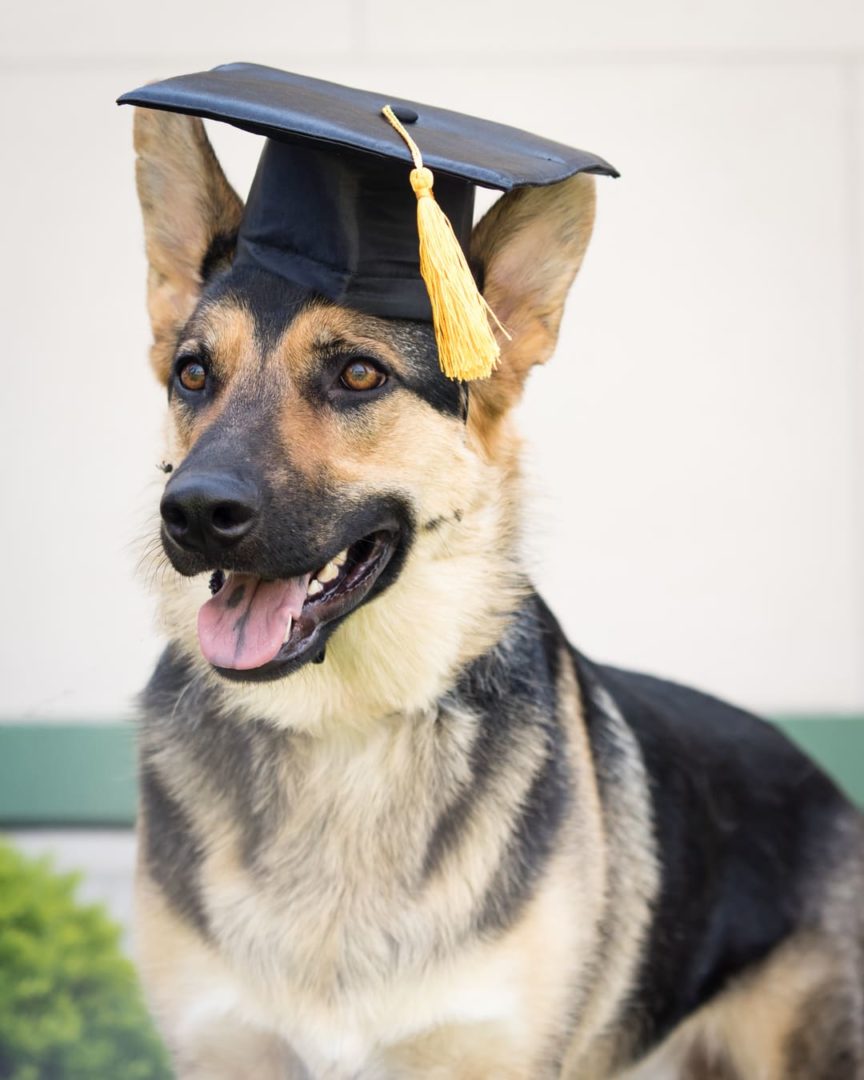

 and companionship of a fur kid. And, as with welcoming any new family member into your home, it’s important to do some advance preparations to ensure the transition is a positive experience for all concerned.
