Thinking of bringing home a new Furry Friend to be a member of your existing pet family? Just a little preparation and pre-planning can go a long way towards keeping the peace in the pack! Our tip sheets below can help you understand what’s necessary in order to introduce a new dog or cat to your existing Furry Friends and understand what’s behind those initial barks and growls. Growing your pet family is a good thing, as long as all involved are treated with consideration, respect and kindness.
Do you have experience at introducing new members to your existing pet family? How did it go? Please post your story or additional suggestions in the comments section below.
Recently, Animal Behavior College President and CEO Steve Appelbaum appeared on “Teacher’s Pet,” a podcast hosted by ABC graduate Nan Talleno, ABCDT. Steve spoke about the care, needs and challenges associated with shelter dogs. His key insight may answer some of your questions and expand your canine knowledge.
Click here to listen to this very special podcast from Pet Life Radio. His points dovetail well with ABC’s Students Saving Lives campaign. If you have former shelter dogs in your home or care for them as a part of your ABC program, you’ll be glad you did!
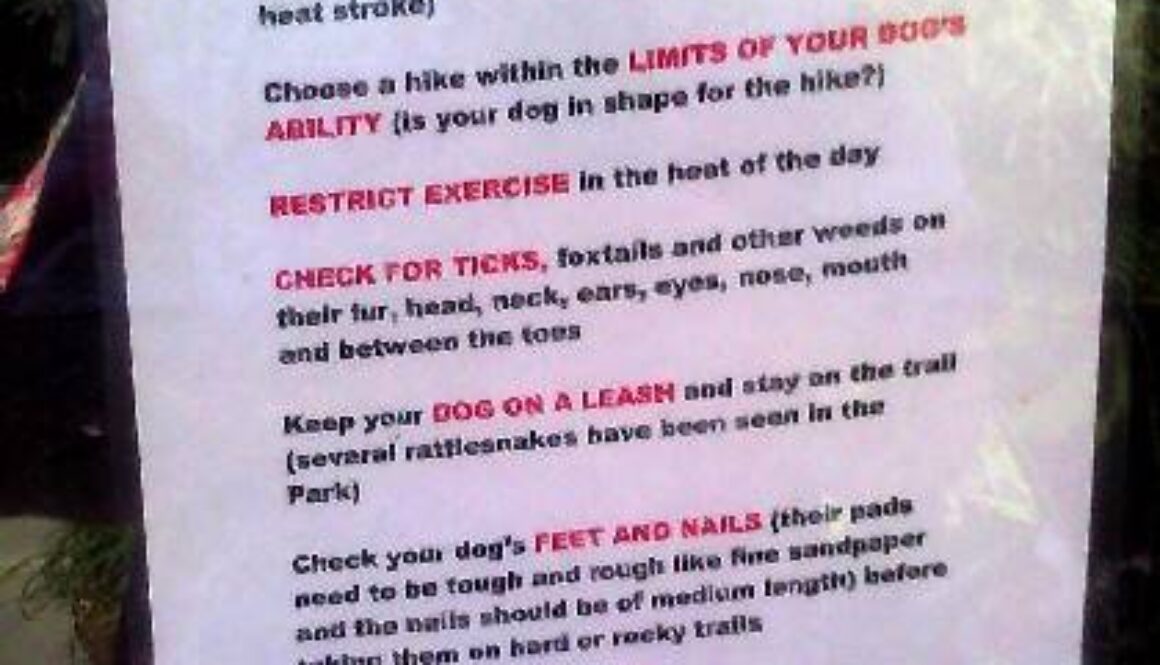
While taking a hike last weekend in a park that borders a major wilderness area just north of Los Angeles, we saw this sign on the right posted prominently on the main message board at the trailhead. It got us thinking about a few things. First, the local rangers were being incredibly thoughtful in assembling tips to help dogs and their masters in the area. Second, was anything missing from this list that mattered?
This sign is specific to the Southern California area. Do you have a tip, idea or piece of advice that would help hikers, campers and others who strike out for adventure with their Furry Friend at their side? We’ve listed some of our best tips and guides below. What would you add? And the more specific to your terrain the better — desert, plains, heat, snow, bugs, weird wildlife, consider all of it. All ideas are useful when it comes to keeping our pets safe, comfortable and happy!
Bringing a new dog home for the first time takes patience and understanding. Introducing a new dog and hoping he gets along with the resident pet requires preparation. Below, we’ve collected our most popular tips for integrating pets into new families. Understanding the ground rules of how your pets’ minds work makes a big difference in whether your new pets get along or not.
Socialize Your Puppy
The main objective of socialization is to teach your puppy how to behave well around humans, animals, and distractions. Socialization begins as early as seven weeks of age and lasts for about 18 months. You want to gradually introduce your puppy to as many sounds, sights, and smells as possible.
Select a Location
When introducing your new dog to your other dog, it’s best you choose a new location. A familiar setting can cause territorial problems. Certified dog trainers recommend having both dogs well exercised prior to meeting each other. Unlike the meeting between two dogs, a room in your home will do just fine for introducing a new dog to your resident cat. Just remember to put a leash on your dog and a harness on your cat to avoid movement.
Whether you’re introducing a new dog to another dog or resident cat, it’s important you maintain a sense of calmness throughout the meeting. If your dog senses your discomfort, he may begin to feel uncomfortable as well. During the encounter between your two dogs, keep a mental note on which dog is the dominant one by observing their interaction. Knowing which one is the alpha dog can help reduce tension between your pets later on. Also, establish yourself as alpha leader.
For the dog and cat affair, move your dog close enough to your cat, but far enough to control your dog’s excitement. From there, offer your dog a treat away from the cat. He will have to make the choice between looking at the cat or eating a treat. Move them closer to each other so they become acquainted with each other.
The process of integration may take a few weeks, but the outcome is well worth it. Just be patient and consistent, and you’ll soon have yourself one happy family.
Are your pets best buds or mortal enemies? Post your story below!
With over 1.5 million views on YouTube, TreT (the American Straffordshire Terrier shown) is trained in parkour and has become a worldwide canine celebrity. This video compels you to watch over and over in wonder.
By way of background, the American Straffordshire Terrier is sometimes referred to as the “cousin” of the American Pit Bull. These dogs can be great pets when properly socialized. Eager to please and especially responsive to those who understand their innate need for a strong pack leader, the Straffordshire requires time, exercise and discipline for best results. Possessing those traits, however, may allow dedicated Staffy owners to glean some of the remarkable results seen in this video!
If you have an active lifestyle and understand the needs of these dogs, they make loyal and loving family pets.
Dogs shaking paws may be one of the cutest sights, but no one does it better than Sammy, the Shih Tzu. In the video below, you’ll find Sammy excitedly wagging his tail and shaking paws with his dog owner. Learn how to teach your dog to shake paws with these dog training tips.
Get your dog to paw at you
Scratch her chest or touch her toenails to have your dog lift her paw at you. As soon as she lifts her paw, click and treat. Repeat this process for at least 15 times so your dog starts associating her paw lift with a click and treat.
Add your cue
Once your dog begins offering her paw without any problems, introduce the dog training cue. In this case, your cue is your outstretched hand. When she lifts her paw, show your hand, click and treat. Repeat this until your dog becomes used to this behavior. When she’s ready, you can then add a verbal cue. You can use “give your paw” or “shake” as your cue to your dog to shake paws.
Practice
The best way to have your dog repeat this behavior is by practicing. Repeat this process in different environments to ensure your dog has learned the behavior. One last tip: take small breaks between each training session. You don’t want to overwhelm your dog.
Professional dog trainers are asked many questions, but the two most common ones about jumping are: “How can I keep my dog from jumping on me or others?” and “How can I make my dog jump over something?”
While it may seem counter-intuitive, training your dog to jump over objects can help prevent jumping behavior. Setting time aside for your dog to jump teaches your dog to only jump on cue and over an object. You’ll need a six-foot training leash, pole and delicious training treats.
Set up the jump
Jumps can be made with a pole, standing stick or even a broom. The height of the jump is established by measuring the height between your dog’s front paw and shoulder and dividing that number by two.
Step over with your legs
Once the jump is set up and your dog is on a leash, approach the jump and step over it. The idea is to have your dog follow your lead. Treat your dog after he jumps over the object. If he refuses, consider using a better treat or lowering the jump.
Add a cue
When your dog is comfortable jumping over the object, it’s time to add a cue word, such as “jump” or “over.” Always praise and treat your dog after a successful leap.
Wondering how to stop your dog from barking? Dog training school Animal Behavior College understands the challenges faced when teaching a dog to stop barking. Many dog owners experience their dogs barking at inappropriate times. ABC’s certified dog trainers offer tips on how to get a dog to stop barking. (more…)
Training your dog to roll over is a fun dog trick to practice, but it can also be a gateway cue for additional dog training techniques like teaching your dog to stay.
Since many dog training cues build upon other cues, teaching your dog as many cues as possible can offer good exercise while building a ladder to other training. Roll over is just such a gateway cue.
Use a reward. Hold it high above his nose and cue your dog to “sit.” You can use either a treat reward or a toy reward for a successful “sit.” Some professional dog trainers have found the toy reward to be very effective as a lure for this dog training practice.
Hold the dog toy or treat at the end of the dog’s nose and slowly lower it to the ground. This action will lure the dog into the “down” position.
Once the dog is down, move the toy up and around his neck, prompting him to roll over and follow the lure of the toy or treat.
When the dog has successfully rolled over, offer him his ball or favorite toy you have used for the lesson.
Do It Again, Repetition is Important
As you proceed through each step of the dog training session, make sure to repeat yourself. Repeating the cue creates the pattern for your dog. Also, after each successful accomplishment is performed by your dog—each step of the ladder so to speak—offer lots of praise and positive reinforcement.
Interested in a career working with dogs? Take dog training classes online and become a certified dog trainer within 12 months! Learn more about our Dog Trainer Program.
Many pet owners love to enjoy the outdoors with their pets. For some, this can be challenging if your dog has not mastered the “stay” cue. Whether you’re at a social outing, a dog park or any other public location, you’ll want to teach your dog to stay when confronted with increased distractions.
The “stay” cue is a great exercise to increase your dog’s capacity to tolerate distractions, building his attention span while increasing his focus and response to you. As with all learning cues, repetition is important until the cue is successfully learned.
How to Teach the Stay Command
1. You’ll want to make sure your dog is on a leash. This is done for safety and also to help manage his behavior.
2. Stand directly in front of your dog and give the “stay” cue both with a hand signal and verbal cue. A traditional hand signal for “stay” is your flat palm held approximately six inches in front of the dog’s nose.
3. Count to three and then immediately drop your hand to your side and release the dog from “stay” by saying “OK.” Reward with praise and treats for a job well done.
4. Gradually increase the duration, distance and distraction level one component at a time.
Repeat and Practice
Throughout this dog training exercise, your dog will learn to focus on you. Also, your dog’s tolerance for enduring distractions will increase and provide each of you with greater assurance of the “stay” cue while in public.
Dogs like consistency from their owners. Of course, this is a two-way street with owners being assured of the kind of behavior they can rely on from their dogs.
Animal Behavior College enjoys a national reputation of being one of the premier dog training schools in the U.S. and Canada. As such, providing ongoing education and information for anyone in animal careers, as well as dog owners themselves, demonstrates examples of best practices in the animal care world.
Wondering how you can become a certified dog trainer? Check out our Dog Trainer Program for more information.
Rating A+ The BBB only accredits the business management of a school, not the quality of the curriculum, or training programs.
STATE LICENSURE AND APPROVAL
Animal Behavior College is a private vocational school approved by the Bureau for Private Postsecondary Education (www.bppe.ca.gov) under the California Private Postsecondary Education Act of 2009 and Title 5. California Code of Regulations Division 7.5. Private Postsecondary Education. The Bureau for Private Postsecondary Education approval means that this institution and its operation comply with the standards established under the law for occupational instruction by private postsecondary educational institutions. Institutional approval is subject to continual review and the institution must reapply for approval every five years.
DISCLAIMER
Please be advised that Animal Behavior College (“ABC”) is the exclusive entity authorized to provide certifications and/or degrees from Animal Behavior College. Moreover, such certifications and/or degrees are only conferred by ABC following a student’s completion of an ABC-administered program. No other entity or individual has authority to confer certifications and/or degrees on ABC’s behalf. Any other entity or individual who attempts to do so is acting without express or implied authority from ABC.
GI BILL® TRADEMARK ATTRIBUTION
GI Bill® is a registered trademark of the U.S. Department of Veterans Affairs (VA). More information about education benefits offered by VA is available at the official U.S. government Web site at https://www.benefits.va.gov/gibill
Animal Behavior College, 27509 Avenue Hopkins, Santa Clarita CA 91355-3910 Contact Us



 Recently, Animal Behavior College President and CEO